If you look back through the manifesto pledges of the two main political parties in the UK over the last 14 years, you will see that many of them have made promises to reduce immigration or strengthen border control.
2010 – Labour (Gordon Brown)
“Control immigration through our Australian-style points-based system, ensuring that as growth returns we see rising levels of employment and wages, not rising immigration, and requiring newcomers to earn citizenship and the entitlements it brings.”
2010 – Conservatives (David Cameron)
“Immigration has enriched our nation over the years and we want to attract the brightest and the best people who can make a real difference to our economic growth. But immigration today is too high and needs to be reduced. We do not need to attract people to do jobs that could be carried out by British citizens, given the right training and support. So we will take steps to take net migration back to the levels of the 1990s – tens of thousands a year, not hundreds of thousands.”
2015 – Labour (Ed Miliband)
“Immigration has made an important contribution to our economic and social life, but it needs to be properly controlled. With a Labour Government, migrants from the EU will not be able to claim benefits until they have lived here for at least two years. We will make it illegal to undercut wages by exploiting migrant workers, and work to strengthen integration within our communities. Everyone who works with the public in our public services must be able to speak English.”
2015 – Conservative (David Cameron)
“Between 1997 and 2009, under the last Labour Government, we had the largest influx of people Britain had ever seen. Their open borders policy, combined with their failure to reform welfare, meant that for years over 90 percent of employment growth in this country was accounted for by foreign nationals – even though there were 1.4 million people who spent most of the 2000s living on out-of-work benefits. For the past five years, we have been working to turn around the situation we inherited”
2017 – Conservative (Theresa May)
“Britain is an open economy and a welcoming society and we will always ensure that
our British businesses can recruit the brightest and best from around the world and
Britain’s world-class universities can attract international students. We also believe that
immigration should be controlled and reduced, because when immigration is too fast
and too high, it is difficult to build a cohesive society.”
2019 – Labour (Jeremy Corbyn)
“Our border security prevents serious crimes including child abduction, people trafficking, smuggling of drugs and guns, terrorism and modern day slavery. The Tories have further weakened our borders, cutting another 200 jobs over the last four years.
They have failed to deliver exit checks. In place of an effective border control they have required landlords, teachers and medical staff to work as unpaid immigration officers, creating a hostile environment. A Labour government will review our border controls to make them more effective.”
2019 – Conservative (Boris Johnson)
“That is why a majority Conservative Government will get Brexit done, and then introduce a firmer and fairer Australian-style points-based immigration system, so that we can decide who comes to this country on the basis of the skills they have and the contribution they can make – not where they come from. Migrants will contribute to the NHS – and pay in before they can receive benefits. Our new system gives us real control over who is coming in and out. It allows us to attract the best and brightest from all over the world.”
2024 – Conservative (Rishi Sunak)
“Illegal migration is unfair. It is unfair for people to jump the queue in front of people who play by the rules. It is unfair for taxpayers to pay for the hotels and public services. And it is unfair for illegal migrants themselves who risk their lives in the hands of people smugglers.
The Conservatives are the only party with a plan to stop the boats and reduce the strain that illegal migration places on our communities and public services. Labour have no plan and would grant an amnesty to thousands of illegal migrants.”
2024 – Labour (Keir Starmer)
“Launch a new Border Security Command with hundreds of new specialist investigators and use counter-terror powers to smash criminal boat gangs.”
Current Migration Levels Estimates
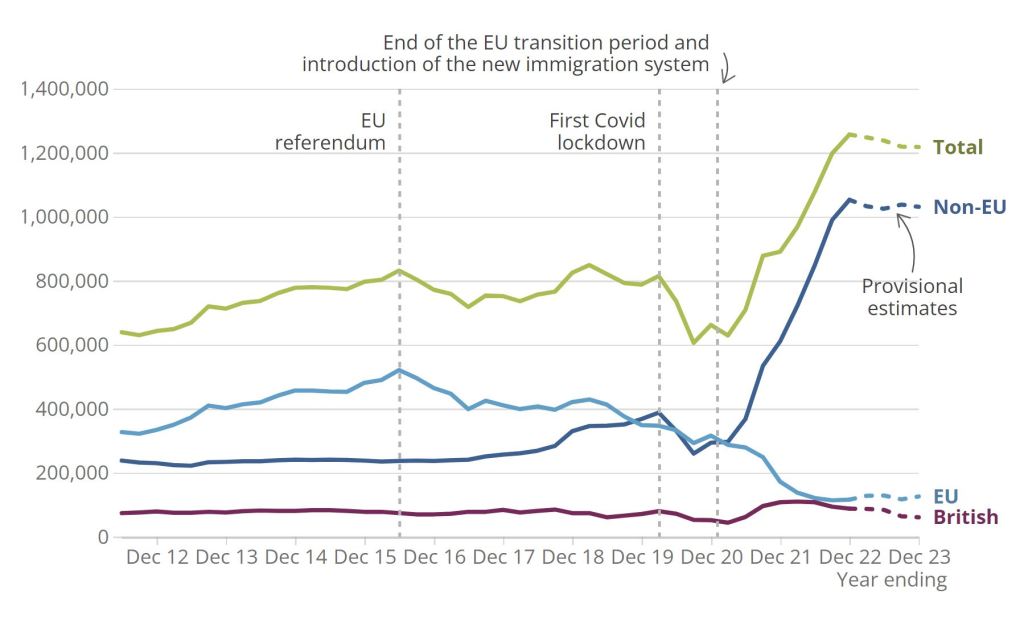
Data from the Office for National Statistics shows that over the same period, total legal immigration into the UK has been estimated to have risen from 639,000 to 1,218,000 with net migration (immigrants arriving less population leaving the UK) estimated at 744,000.
That is the equivalent additional population of a city the size of Nottingham arriving each year yet for the year ending March 2023 only 210,320 dwellings were built to completion in the whole of the UK and according to the 2021 census 1.1 million homes were already classified as over-crowed.
Illegal Immigration
In terms of migrants arriving by trafficking via illegal boats, the Home office keeps track of numbers of arrivals and boats that successfully make it to the UK.
| Year | Migrants Arrived | Boats Arrived |
| 2018 | 299 | 43 |
| 2019 | 1,843 | 164 |
| 2020 | 8,462 | 641 |
| 2021 | 28,526 | 1,034 |
| 2022 | 45,755 | 1,110 |
| 2023 | 29,437 | 602 |
| 2024 ** | 17,639 | 343 |
* Data collated from https://assets.publishing.service.gov.uk/media/66b5e7e9fc8e12ac3edb0d41/08_Aug_2024_Small_boats_-_time_series_New_draft.ods.ods
** Data up to 08 August 2024
According to the Home Office, of the 129,407 initial asylum decisions received between 15 April 2023 and 14 April 2024, 93,431 were substantive decisions (56,834 grants and 36,597 refusals, which is a grant rate of 61%).
Home Office statistics published in February 2024 show that the accommodated asylum population (hotel population) on 31 December 2023 was 45,768.
This is just migrants entering the UK illegally. In addition to this there are migrants that entered the UK with a valid visa but no longer have a valid visa.
Overstaying visas
The latest data available (published August 2020) stated that of the 1.9 million visas that expired upto March 2020, 91,612 or 4.8% were not recorded as having left the UK. However, this does not include non-EU nationals from certain countries that are allowed to stay in the UK for six months without having a visa. According to Migration Watch UK, this could be an additional 250,000 people per year.
Legitimate concerns
Many people are concerned about both the scale of immigration and community cohesion and whilst the data does show that net migration may just be starting to fall, many feel that successive governments have failed to address the concerns despite making promises to do so.
Why has immigration increased?
So why has immigration been increasing despite the promises to reduce it? Prior to Britain’s exit of the European Union, the freedom of movement guaranteed by EU member states to its citizens meant that the UK was powerless to control the numbers migrating to the UK from other EU countries, including new EU member states.
For the year ending December 2018, it is estimated that 424,000 EU citizens migrated to the UK compared to 342,000 non-EU foreign nationals. That figure fell to 151,000 EU nationals by December 2022, with non-EU nationals rising to 925,000. Source https://www.ons.gov.uk/peoplepopulationandcommunity/populationandmigration/internationalmigration/bulletins/longterminternationalmigrationprovisional/yearendingdecember2022
The reduction in EU national arrivals has been counterbalanced by a vast increase in non-EU migration. For the year to March 2023, 487,771 working visas were granted including 69,423 skilled worker visas and 101,570 Skilled Worker – Health and Care visas and 477,931 sponsored study visas.
A skills shortage?
The nature of these visas may be an indication as to what one of the significant factors in immigration numbers might be. A big skills shortage, particularly in health and social care.
According to Kings Fund, there were 111,000 unfilled vacancies in the National Health Service despite a 30% increase in staffing levels since 2009. Why do we need so many more NHS staff? The waiting list for Hospital treatment has grown from less than four million in 2008 to nearly 8 million in 2024. Hospital services are clearly not improving despite an increase in staff numbers. The estimated over all population has increase from 62 million in 2009 to 67 million in 2021 but even so, population growth can’t be the full explanation.
Demographic timebomb
When you drill down into the make up of the population, you start to see a bigger picture. Lets start with birth rates. In 1963 there were 18.3 births per 1000 people in the UK. By 2009 it was 12.524. It is currently 11.171. The average woman had 2.83 children in 1963 and now it’s 1.75. When the fertility rate drops below 2.1, that means the population is in decline, which has been the case since 1973 in the UK. Source. The same pattern is occurring in much of the Western world.
The combination of a larger ageing population that are living longer than ever before and a decreasing working age population is a demographic time bomb. For a welfare state to function, you need more people paying into the system than those using the resources provided but when a larger population ages and the younger population is much smaller, you have a big problem. Economically inactive immigration only adds to the burden but working migrants can be a benefit.
The migrants are needed to fill the gaps as older workers retire and to provide the complex care our ageing population needs. We need the skilled labour to keep services like the NHS running and we also need the cheap labour that keeps the costs of food and social care lower.
The government doesn’t want to tell you this because the consequence is that public spending will have to be cut including NHS services, pensions and benefits plus taxation may have to increase. The quality of life in the Western world has peaked and is on the decline.
Blaming the problems in society on levels of migration is actually quite convenient for governments, it keeps the focus away from a much bigger problem that is impossible to solve. If some people are using excessive migration as a scapegoat for their problems, the government is using them as a scapegoat for not being able to address the wider problems.
Having said that, the immigration concerns are not unfounded. It’s not just about the numbers, it’s about whom we are importing because there is a tendency to import issues from other countries. For example, there have been disturbances in the UK caused by large communities of Muslims and Hindu’s clashing in places like Leicester that mirror the tensions between India and Pakistan.
Extremist religious views and anti-Western sentiment is being imported into the UK. If left to fester, this is going to create more issues in addition to the issues such as inflation caused by the government devaluing its own currency by printing too much money in response to the 2008 crash and COVID pandemic.
We need immigrants that are economically active but we need to do a better job at vetting those that enter the UK and those already in the UK that despise British culture and values or our values will shift and become less liberal and less tolerant of others. It’s going to become harder as more young people become disillusioned with life and feel that they do not have opportunities to improve their circumstances. Young people without hope are much easier prey for extremists that will offer a pre-made excuse and a non-peaceful solution. We must be careful not to alienate young people with polarised rhetoric that drives them to violence, be it anti-Muslim sentiment, anti-Jewish sentiment, or even climate extremism for that matter.
Stopping people trafficking might not do much to the UK population over all, but it will make people feel heard. Deporting foreign criminals and applying the rule of law equally to all communities will help too.
My dystopian fear is that the ideal solution for Western governments would be some kind of virus that wipes out large sections of the elderly community without touching the younger generation. In the past their has been an alignment between mass unemployment and war as it conveniently creates employment and reduces the working age population but this time it’s a lack of younger people that is the problem.
Perhaps if we had a government that incentivised families and reversed the trend of lower birth rates, eventually, the population could recover.
 Rant Over