Seconds from disaster to soaring through the clouds

Hello world, it’s been a while.

The last few years have been a rollercoaster and this is not the end, it’s not even the beginning of the end, but it may be the end of the beginning.

Back in 2016, life was good. I was finally making good headway in my career, feeling valued and appreciated. I was working on my weight, although progress was limited, and my relationship with my wife was at it’s peak. That’s not to say that life was perfect but things were generally on the up, with lots to look forward to in the future.

The covid period changed a lot of things for many people. I do sometimes wonder how different would life’s trajectory have been had covid not happened but it’s pointless ruminating on things that you cannot change from the past. I didn’t enjoy the social isolation of working from home. It destabilised me massively. I began to struggle with self doubt and imposter syndrome. There was a lot of change and change for the worse. My weight was out of control, my mental health was crashing and nothing seemed to help. I tried therapy, I tried numerous different antidepressants. It had very little impact other than making things worse.

Just when it looked like things were about to change for the better with the prospect of a new purpose as a father, my then wife had a miscarriage. Her personality changed and I didn’t like the person she had become. Selfish, manipulative, lying, cheating. It lead to the collapse of our marriage as I couldn’t trust her. I lost my identity. Everything that made me, me was crumbling beneath my feet but sometimes you need the rainclouds to see the rainbow. Diamonds are forged under pressure.

I felt like I was a plane crash waiting to happen. All thrust lost from my engines and just gliding towards terraferma, waiting for the inevitable thud. No kerosene left in my tanks to restart the flamed out engines, no hope. Life looked bleak and I wanted it to end.

I was the sort of person used to doing it all on my own. The reliable one that fixed things for other people. Looking like a swan, calm on the surface but paddling for life under the surface.

I had no fight left, I couldn’t carry all that weight on my shoulders on my own anymore. I needed support. Admitting you need help is a very vulnerable feeling and you soon find out who the people you can count on are in the time of a crisis. A few guys at Andy’s Man Club were there for me through it all, at my lowest ebb, being sat in a pub doing a quiz the night I found out my wife had been lying, being sent pictures of her infidelity from the man she told she was single.

I was plunged into crisis and those lads were there for me. It wouldn’t have been easy to get through to a despondent Jon that had all but given up on life, but they didn’t give up on me and I came through.

I had a couple of really good friends that wouldn’t let me quit. They kept my head just above the water when I wanted to let go and drown. Having to admit to family that my relationship had failed was very painful after 20 years of relative stability but they were in my corner when I needed them and now I have a closer bond with them.

I lost one family, people I had invested heavily in, helping them through their own tough times deserted me without a second thought and that hurt as much as the original betrayal but in a way they did me a favour as it brought me out of my sense of despair and back into determined street fighter Jon, with a point to prove.

There’s only one way to go when you’re at rock bottom, and that’s up.

Bit by bit I refound myself. I kept myself busy. Monday nights were Andy’s Man Club. I went from bursting into tears at my first session, thinking my wife would be better off if I was dead, to becoming a facilitator and helping welcome new members and running session to taking the responsibility of leading the facilitators and keeping the club going. I don’t do it on my own. I’m surrounded by a great bunch of guys and it’s a real honour and privilege to serve the club that got me through the worst crisis of my life. Andy’s Man Club was my life jacket and without it, I wouldn’t be here now.

Having moved out of the family home, buying my own place on my own, it took a while to adjust. It could be quite lonely at times so I stayed out. I was doing pub quizzes with my friend to keep myself distracted. I focused on making my house reflect my personality and creativity. I spent more time with my dad than I had for years. It’s brought us close and we’re going to be going on holiday together for the first time since I was a teen next month.

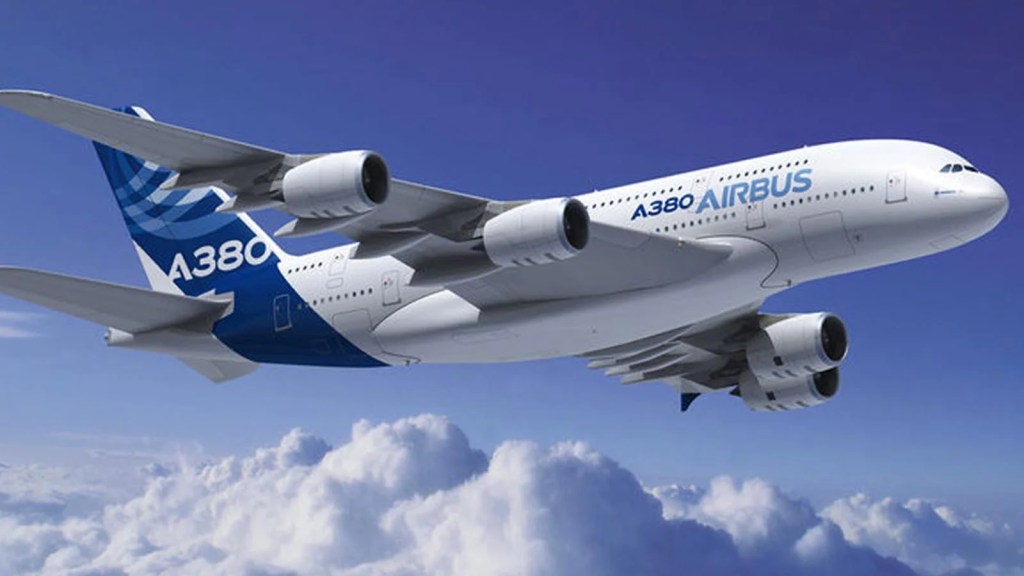
Rather than focusing on what I had lost, I was reinventing myself. I found my reserve fuel tank and one by one, I’ve started reigniting those four magnificent Trent 900 engines again.

Settling in at my new home and making it mine was the first reignition. A cockpit fit for a pilot. It’s taken a lot of effort to get things right but even having my home flooded didn’t dampen my resolve. That was a litmus test for me, it’s how I realised my resilience was back.

I had a bit of fortune at work, my boss was very good to me through the difficult patch, allowing me to try a different role then come back when I was ready. I started regaining my confidence and now feel like I’m thriving again. There was a point where I felt like throwing in the towel and quitting, but I gave it time and it’s really paid off. I’ve gone from fearing the future, feeling incredible anxiety just at the thought of turning my laptop on, to being on the verge of promotion, enjoying my job and looking forward to the future.

I’m no longer ruminating over the past, or worrying about the worse possible case scenarios for the future. I live in the present and handle each new challenge as it comes up. It’s not my ability that has changed, just my mindset.

If work was engine number 2, number 3 is my physical health. My mental health has improved dramatically. I no longer need antidepressants and I’m sleeping better. The next challenge is to get my body right. I’ve had a few wobbles but I’m heading in the right direction. I’ve lost a bit of weight but in a sustainable way, no extreme diets. Weight loss surgery is an option on the horizon, I’ve signed up for Man Vs Fat, which gives me the accountability and routine I need and I’m ready to focus. There will be turbulence on the way, but I see a pathway on the radar. The belief is back that I can do it, the only thing that can hold me back is me. The time wasn’t right when I was still trying to stabilise but now, I’m ready to power up number 3.

The final engine to reignite is finding a co-pilot. I’ve gone through a few different stages from fear and feeling like I needed a relationship after being in one for so long. I’ve had a few and that’s built up my belief that I do have something to offer but now I’ve rebuilt my cockpit, I’m more discerning about who gets to sit in that co-pilot seat. I don’t need a relationship anymore. I’m happy as I am. I have a good life with friends, family and lots of different activities going on, but journeys are more fun when they’re shared and I would like someone in that seat but I’m not going to let someone take that seat unless they are investing in the relationship too. it’s difficult to find a co-pilot when you’re busy flying a superjumbo.

I’m confident that all four engines will be throttled up to TOGA thrust in time. Nothing worthwhile is easy and nothing easy is worthwhile but I can be proud of how far I’ve come and the scenery from 30,000 feet is going to be worth the climb.

The real message here is never give up. We can’t control the turbulence in our path or the behaviour of other passengers in the cabin, but we can control that sidestick, so just keep aviating. It’s worth going through the turbulence patches because when you come out the other side, the sense of accomplishment is worth the struggle. Surround yourself with positive people that have your best interests at heart but ultimately it’s your journey so make the best of it. It’s ok to need help. It’s ok to fail. Every success is built on the back of a thousand failures.
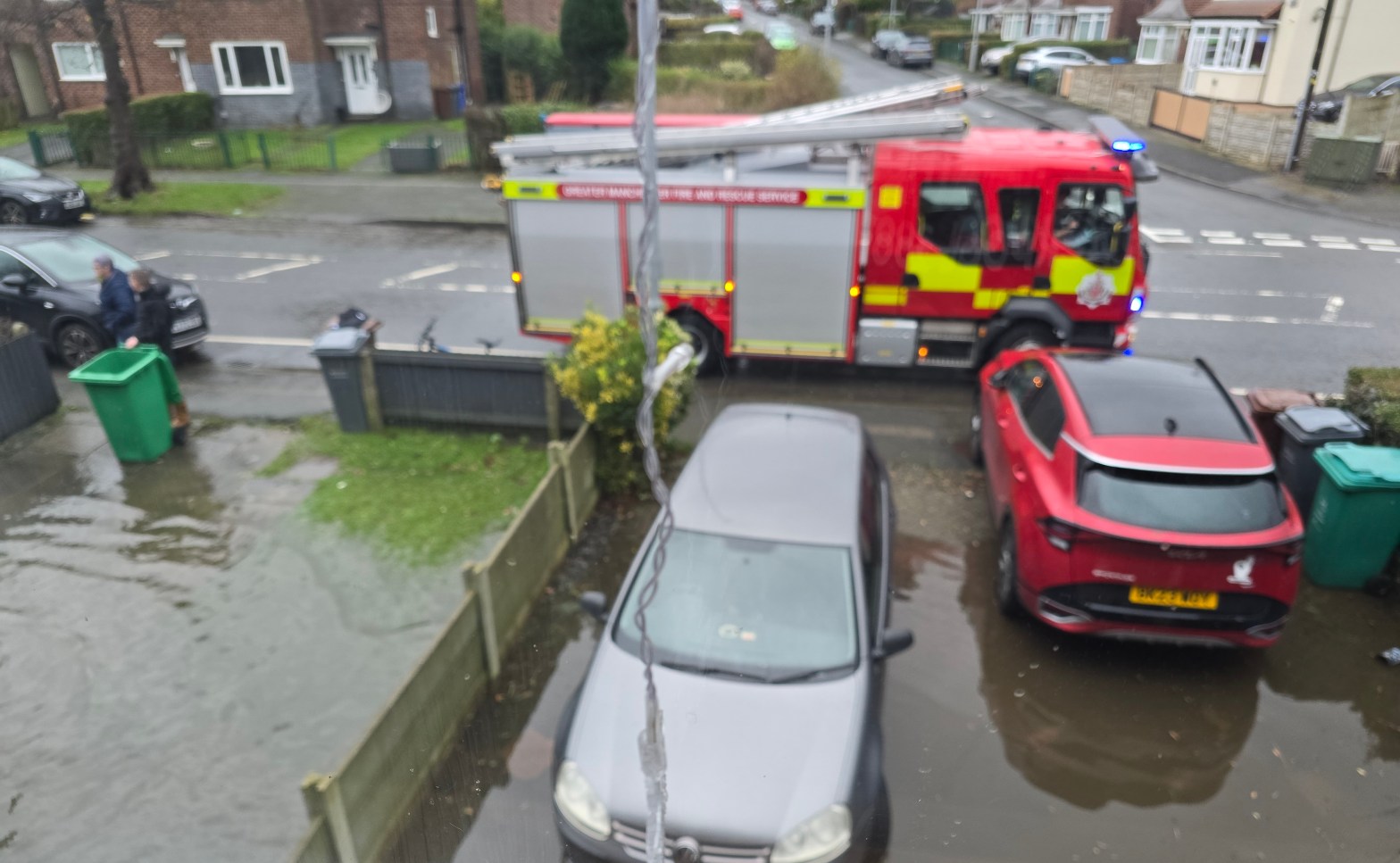
A wet start to the year

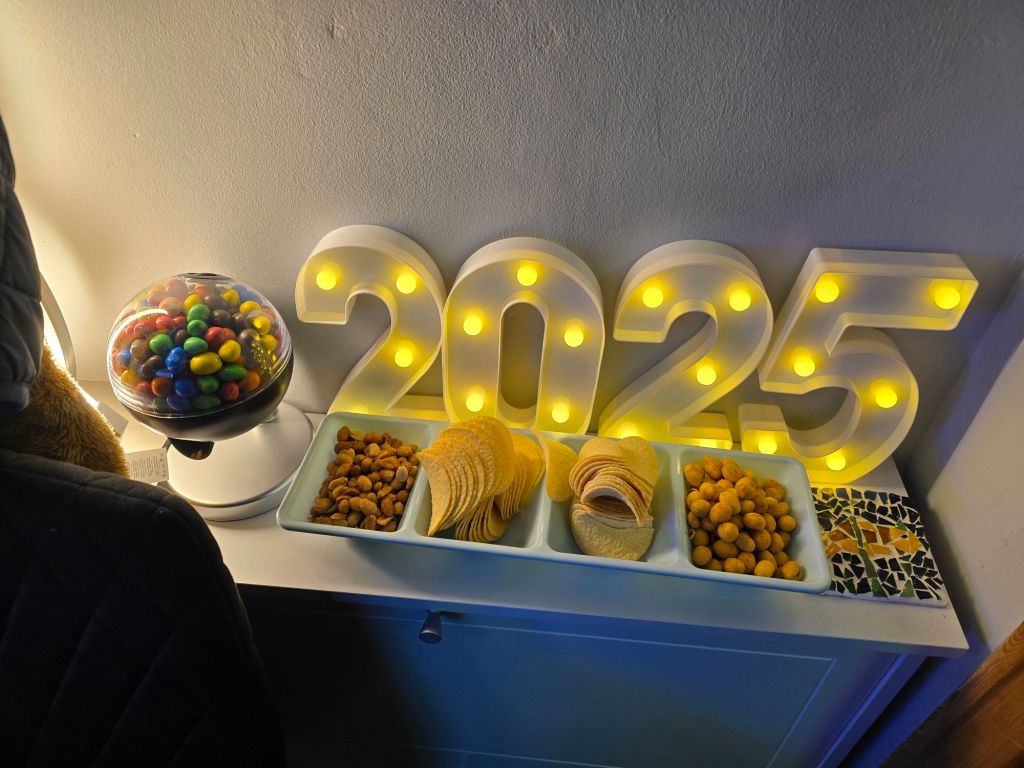
It’s 31 December 2024, and I’ve finally got my house the way I want it after some recent finishing touches.

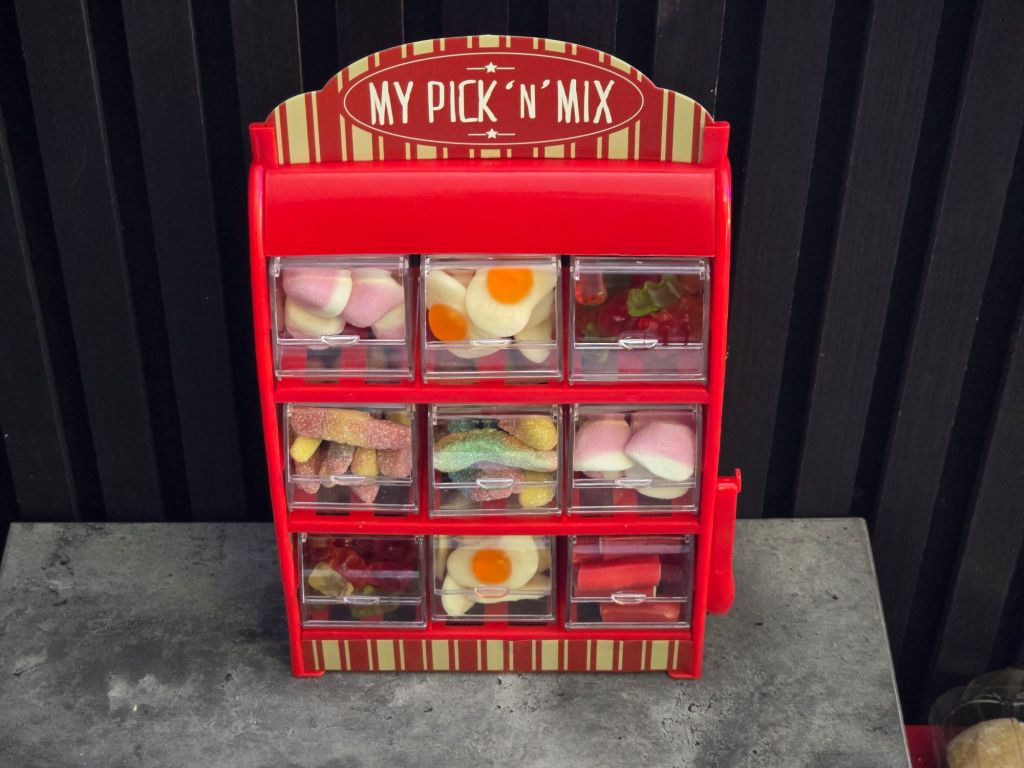
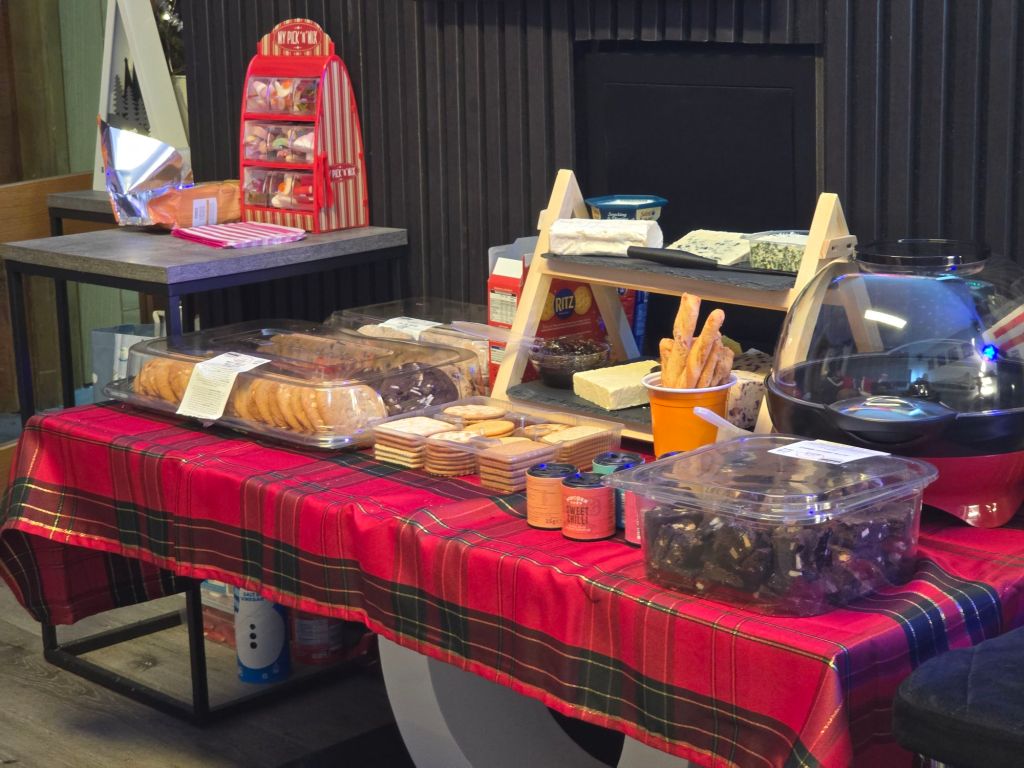
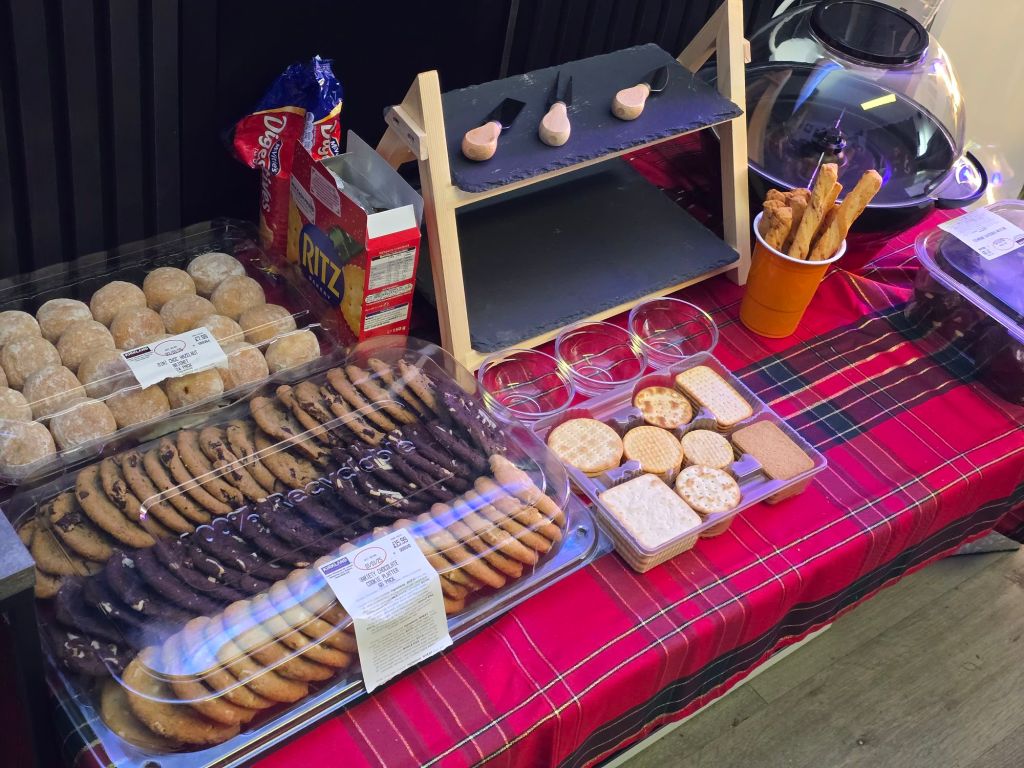
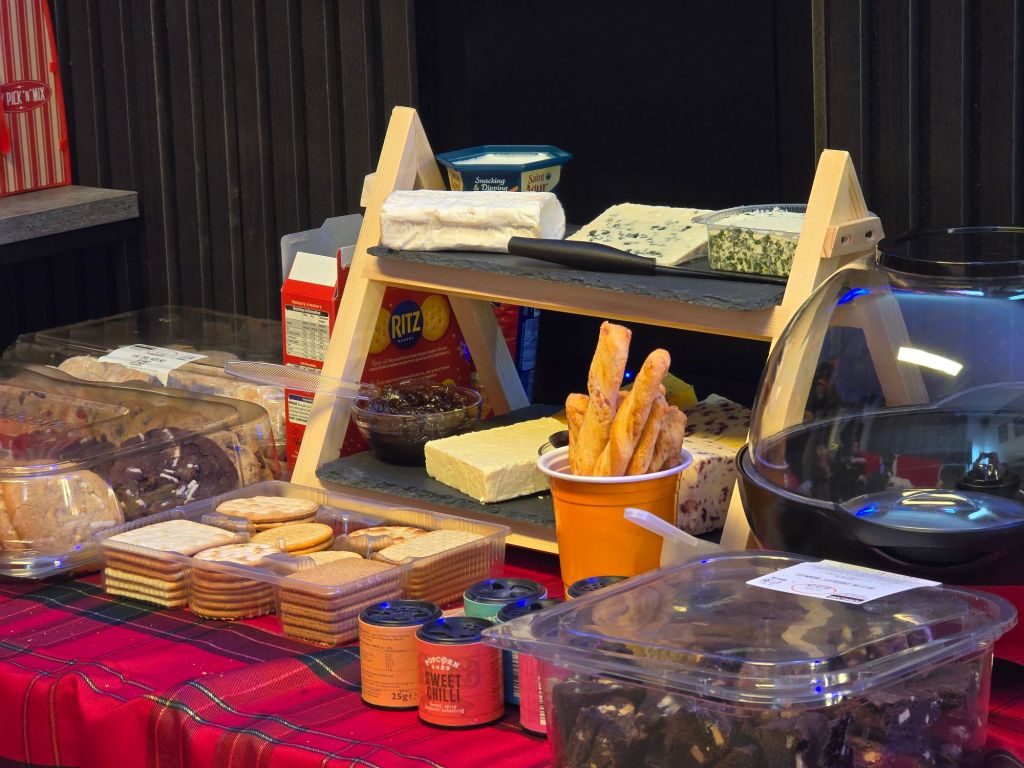
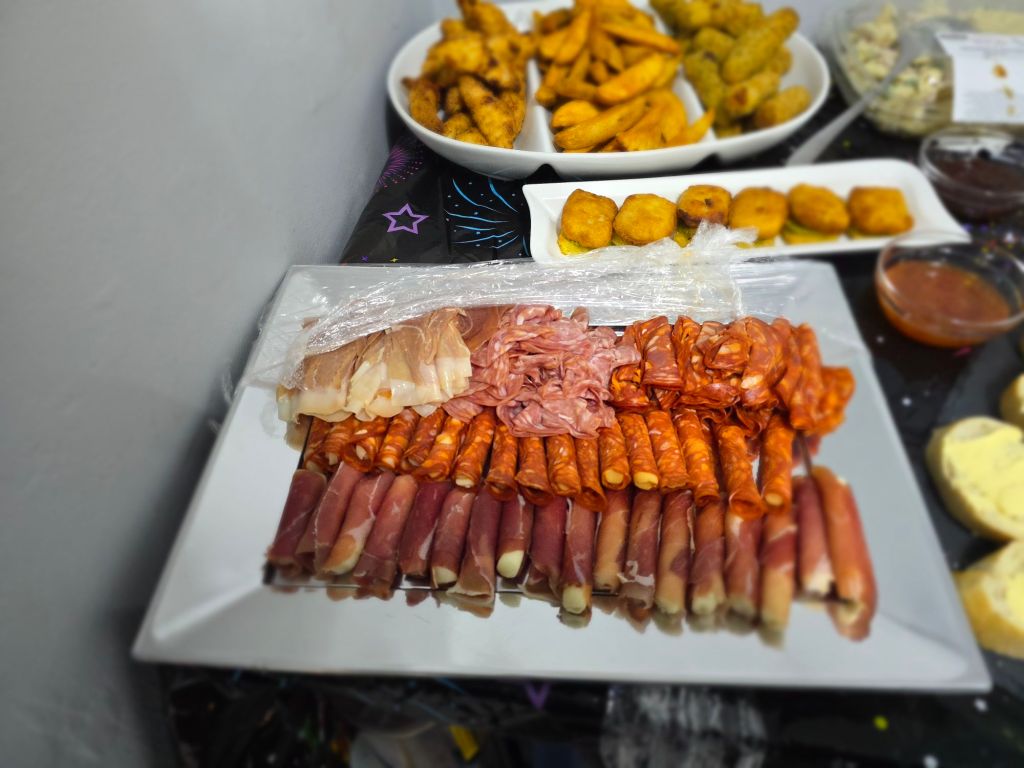
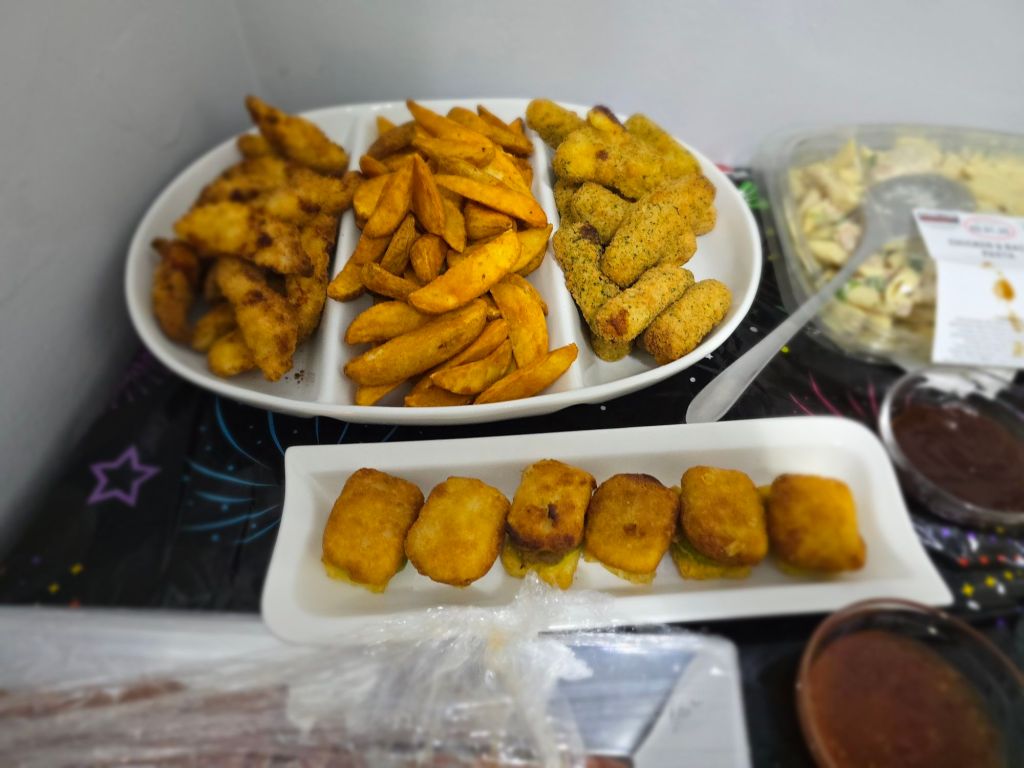
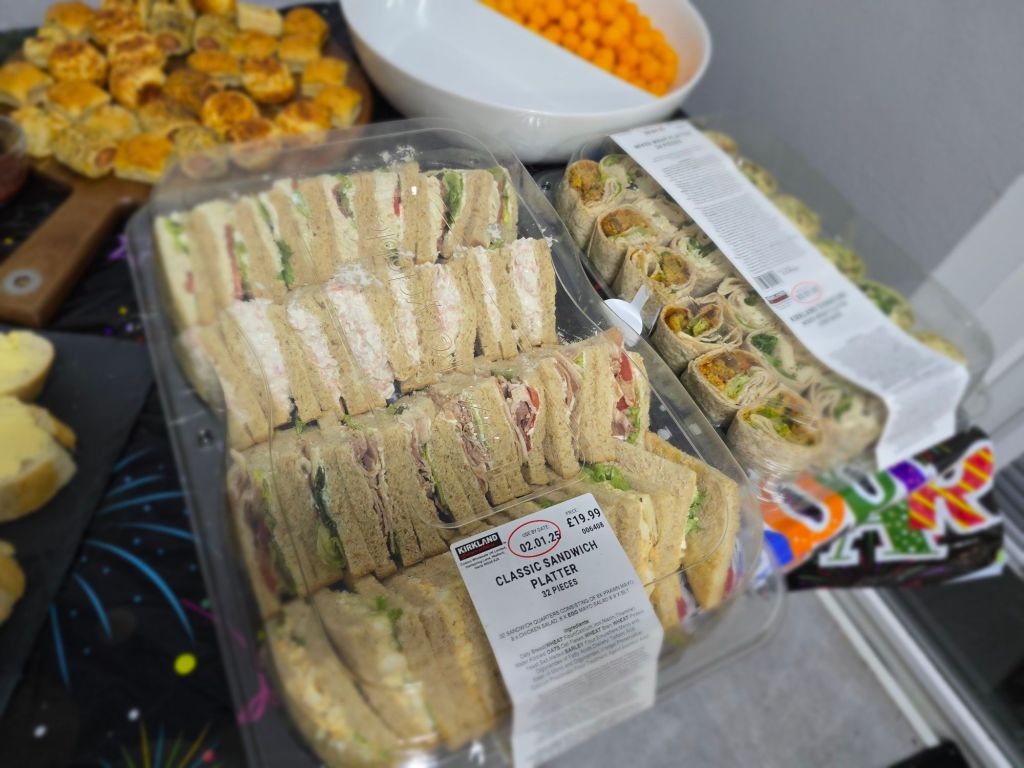
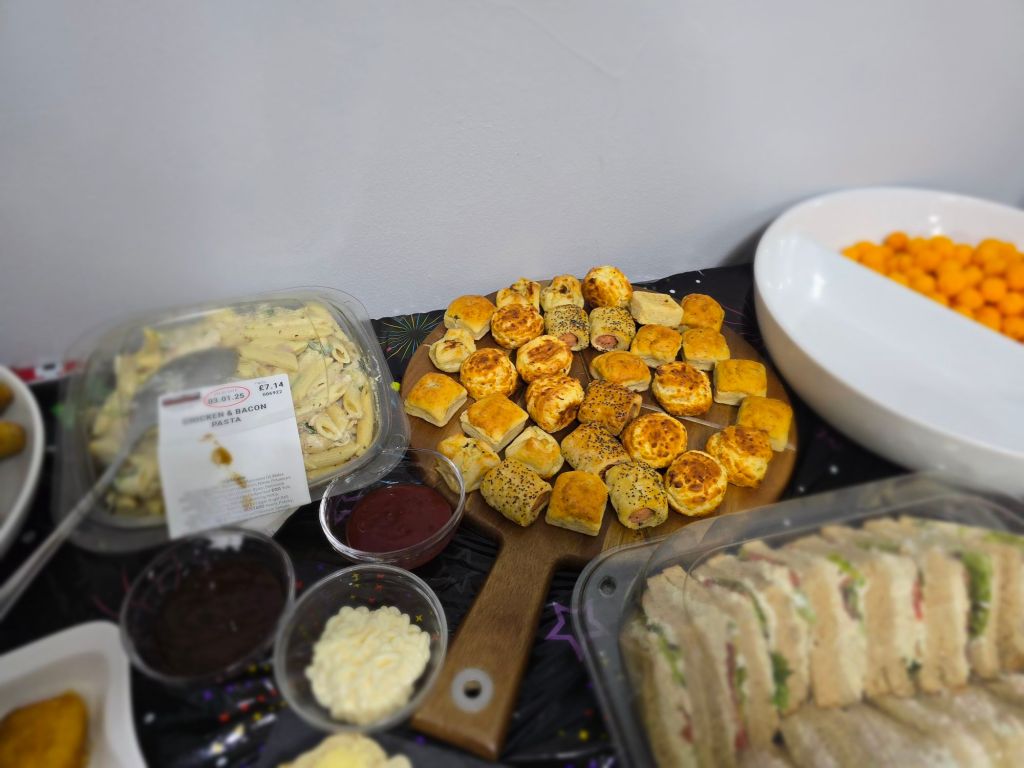
I’m in an excited mood, preparing to host a party for my family tonight. I’ve spent about £300 on food and party stuff to make everything perfect.

New Years Eve has always been very special to me. When I was a child, it was big parties at my Aunty Mary’s and I was a bit shy and it was overwhelming but also filled with happy memories and now it’s become my think to host as a homage to my aunty who passed away a couple of years ago and my uncle who passed last year.

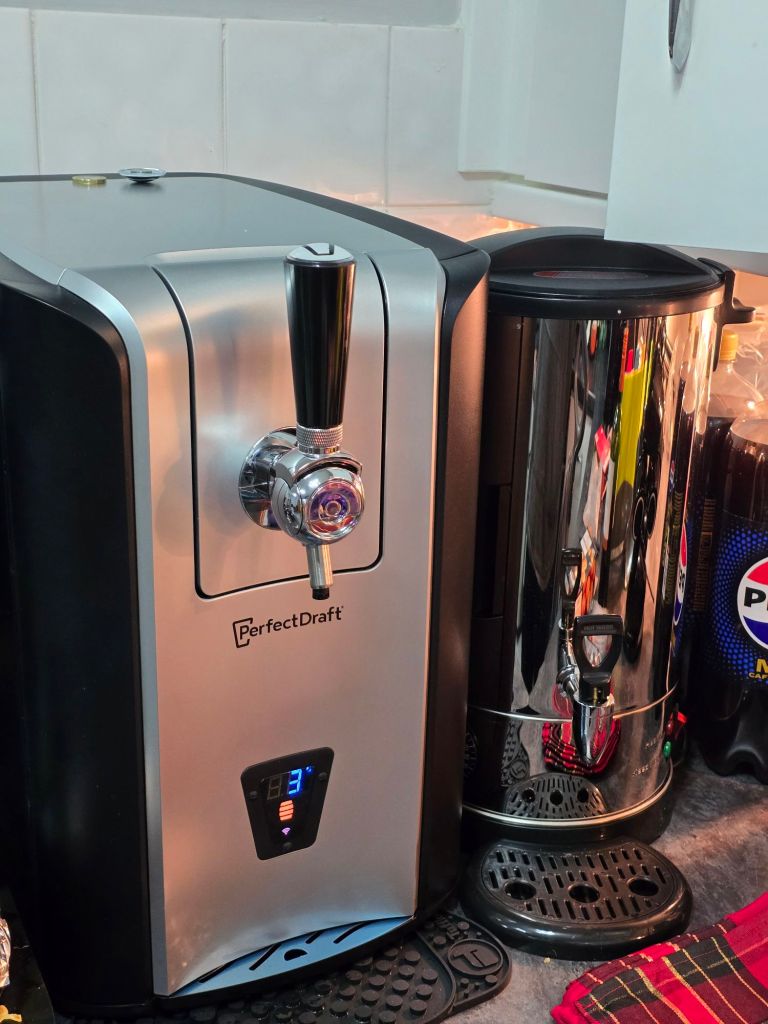
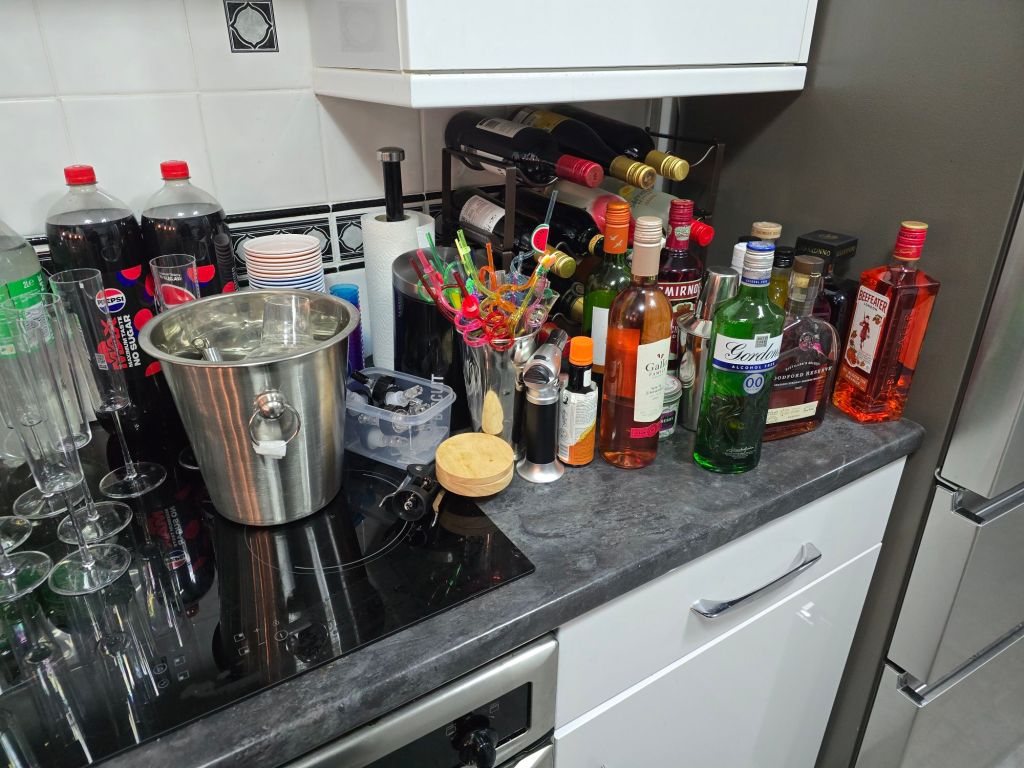
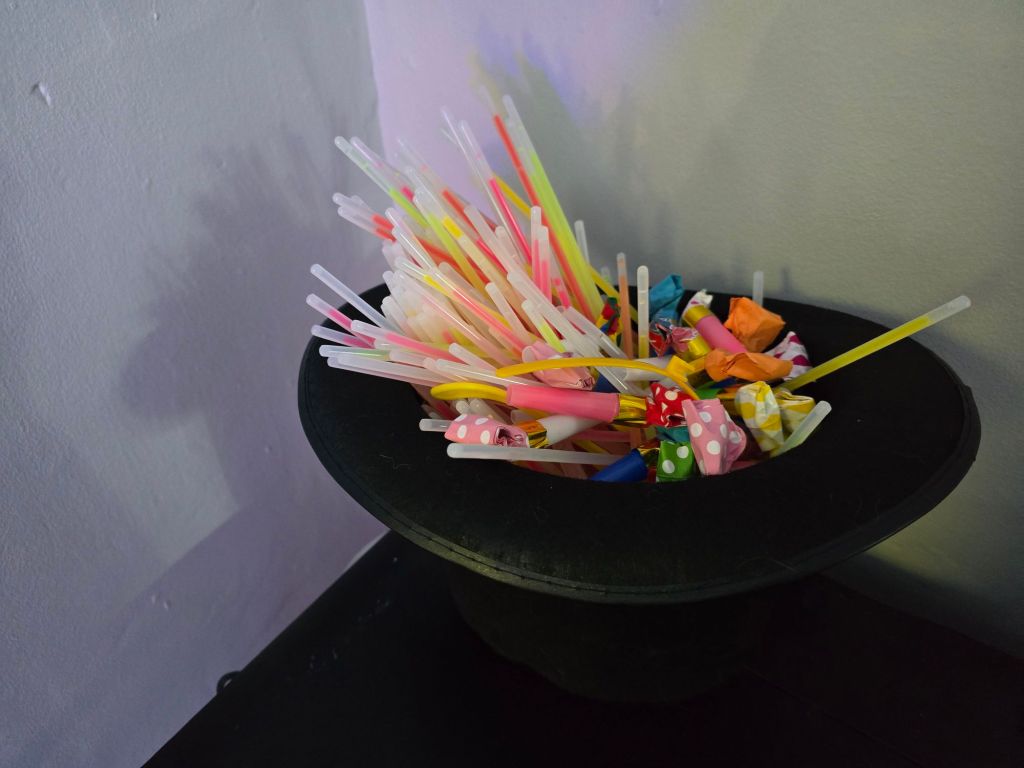
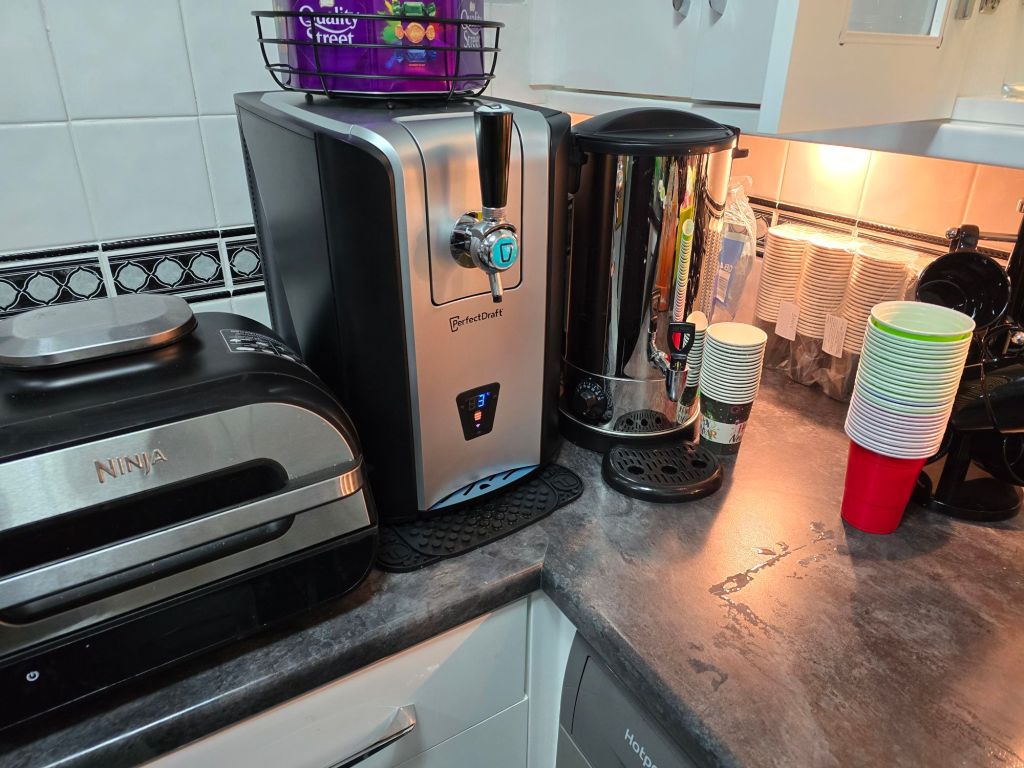
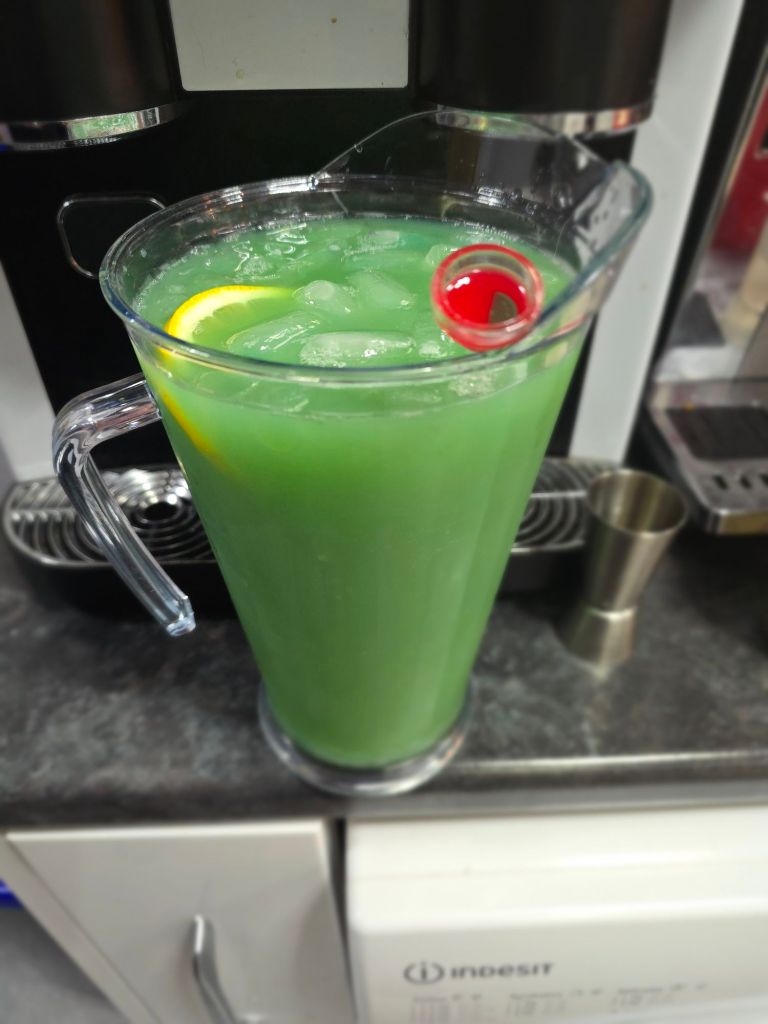
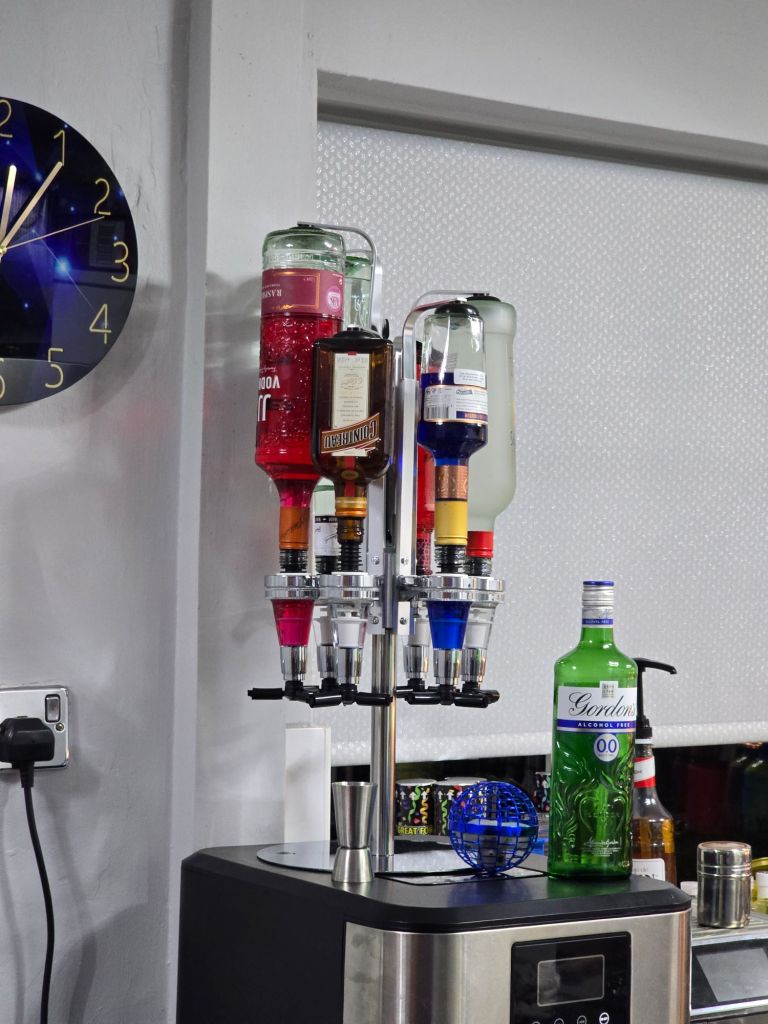
I had disco lights, bubble machines, smoke machines, LED foam tubes, glowsticks, sparklers, party poppers and party cannons. There was draft lager on tap, hot mulled wine, and every spirit you could imagine.


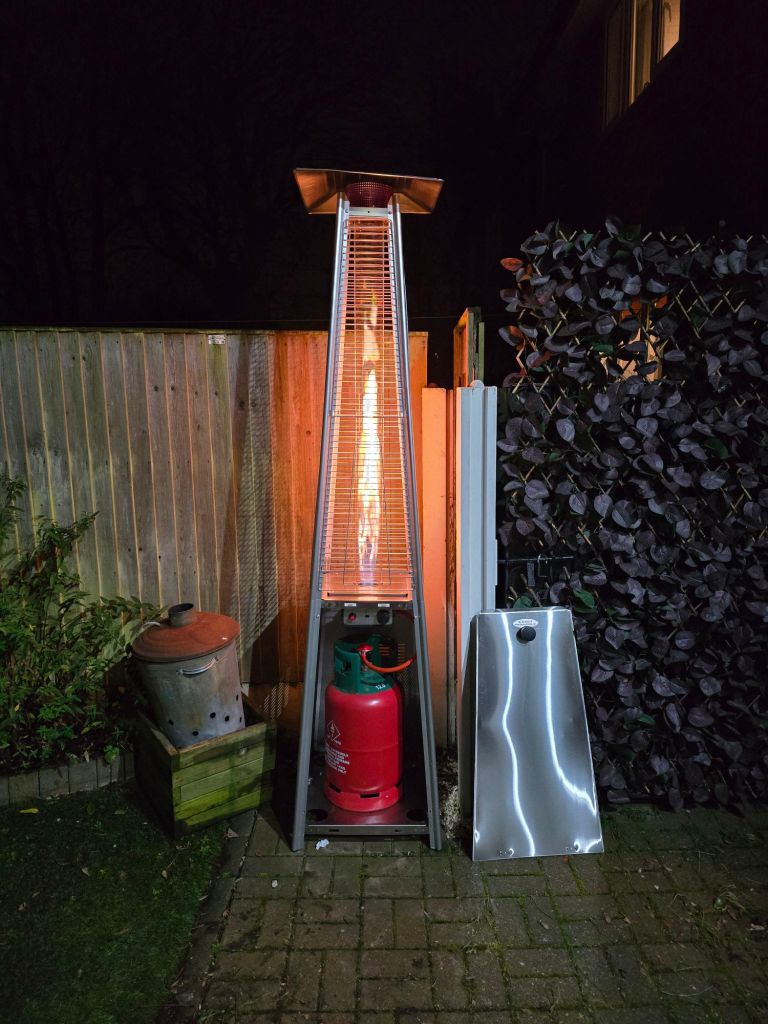
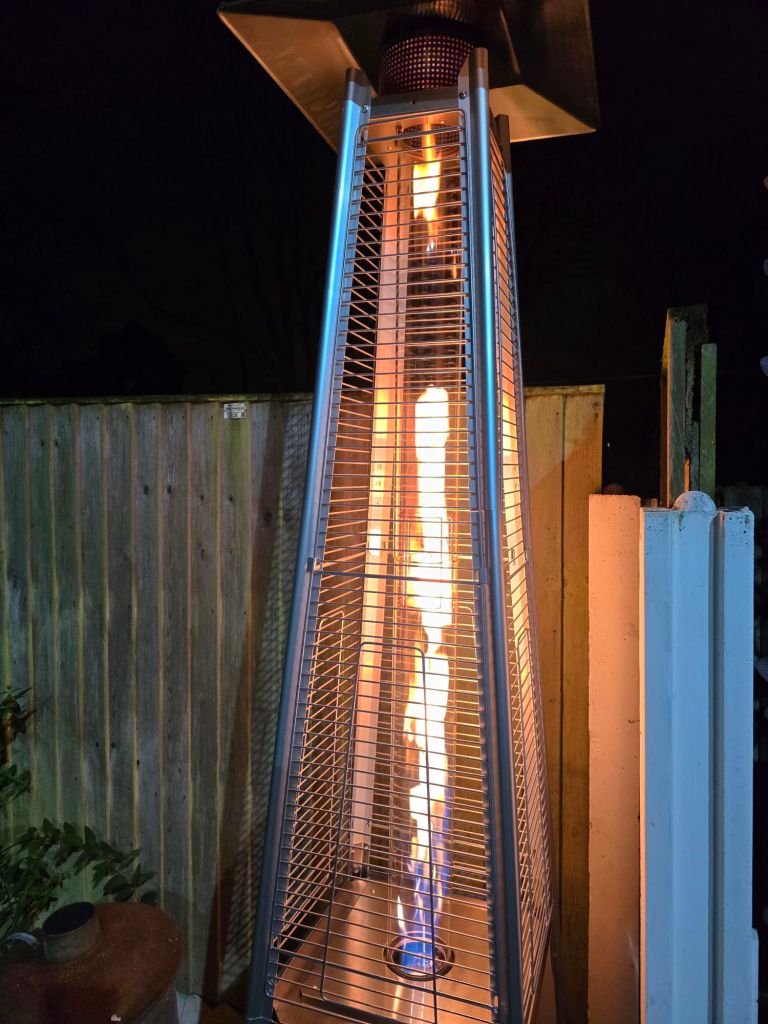
It was a great party. Lots of hard work, but great. We were planning on using the garden, I had a firepit, giant parasol, and patio heater to keep us warm, but it had been raining all day, so we stayed inside.

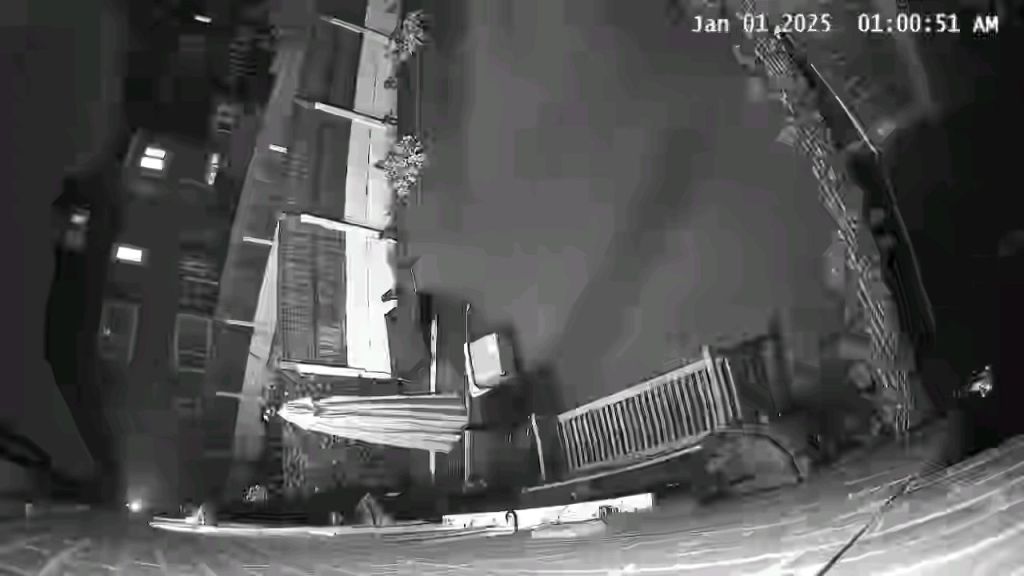
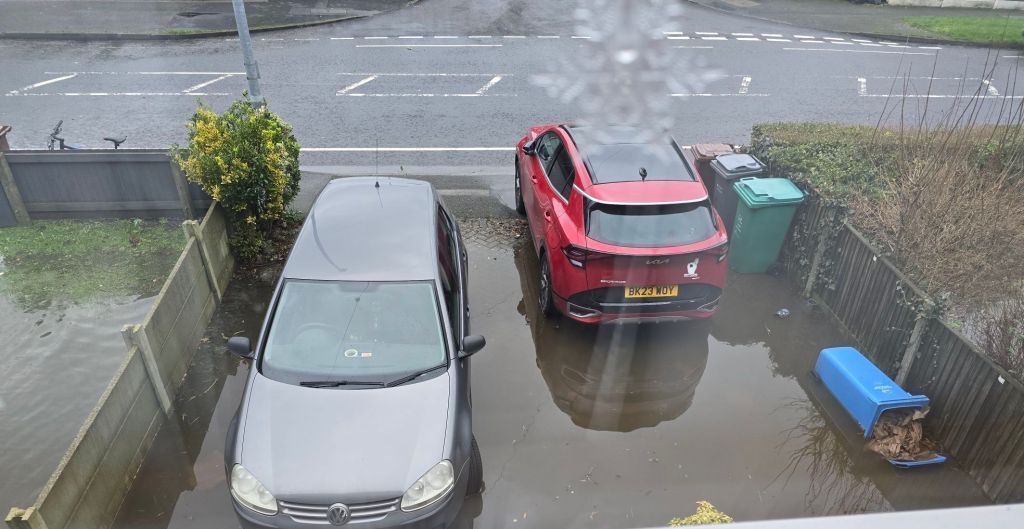
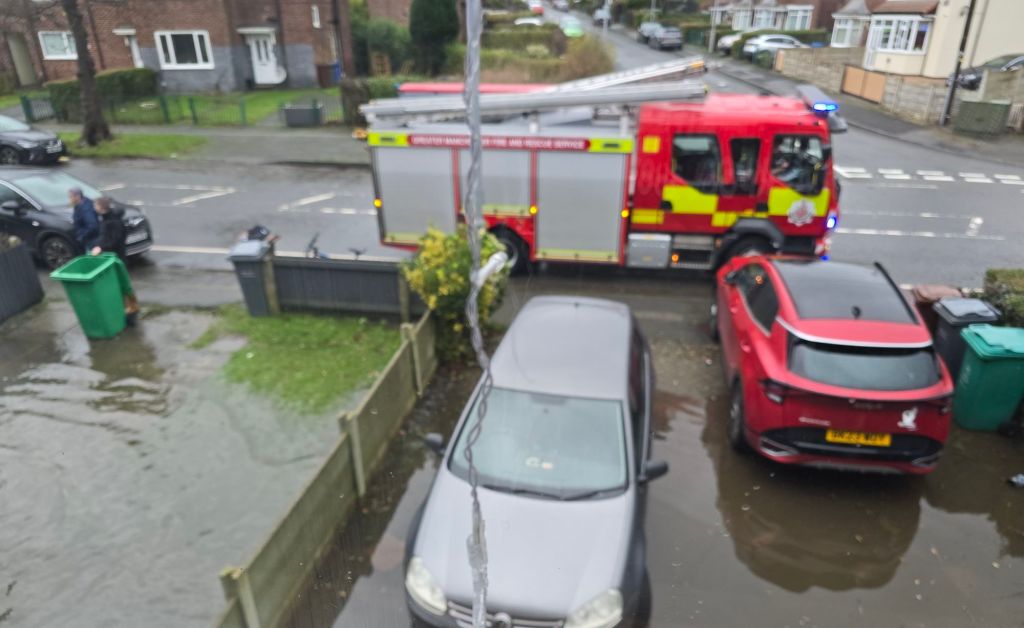
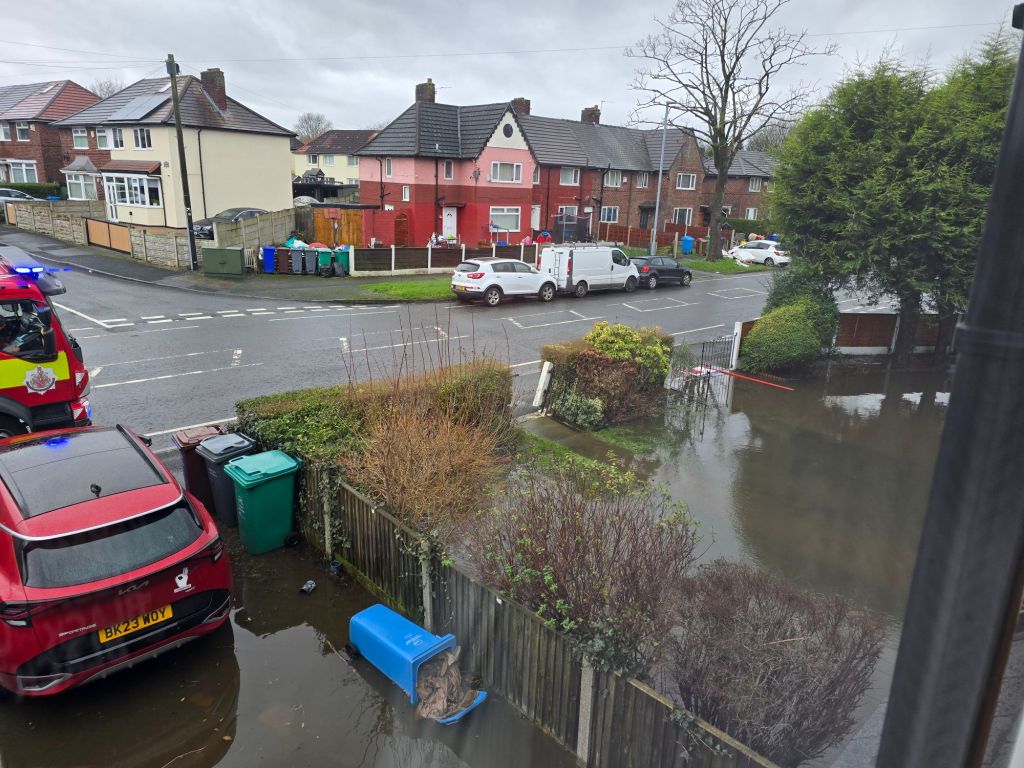
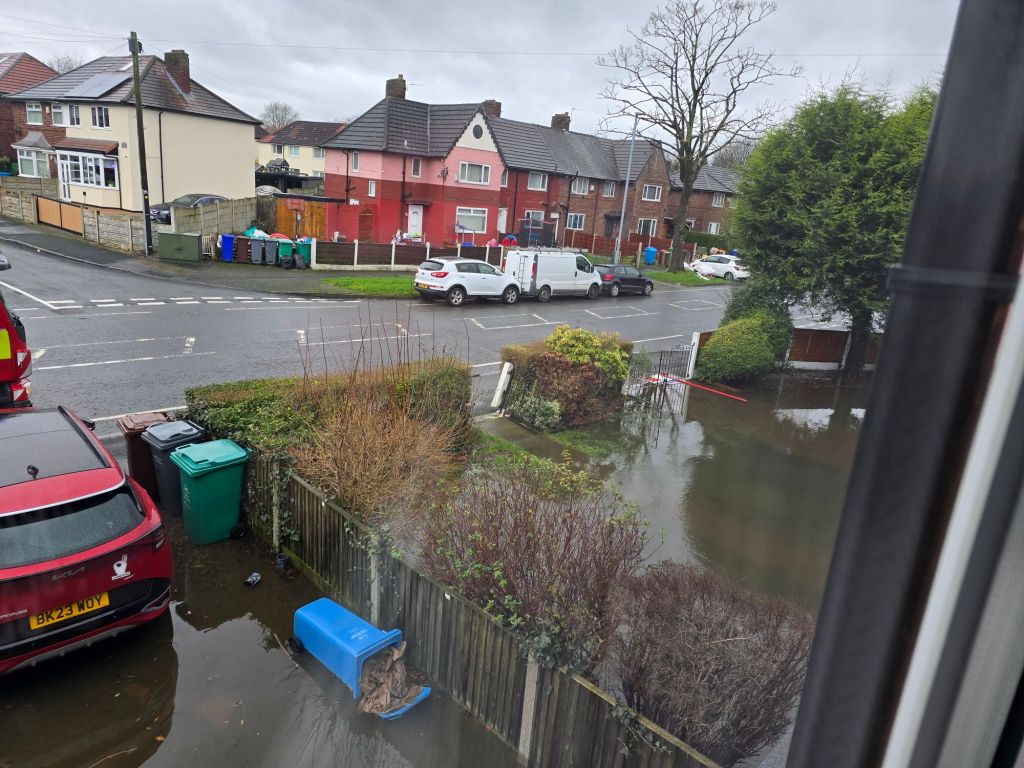
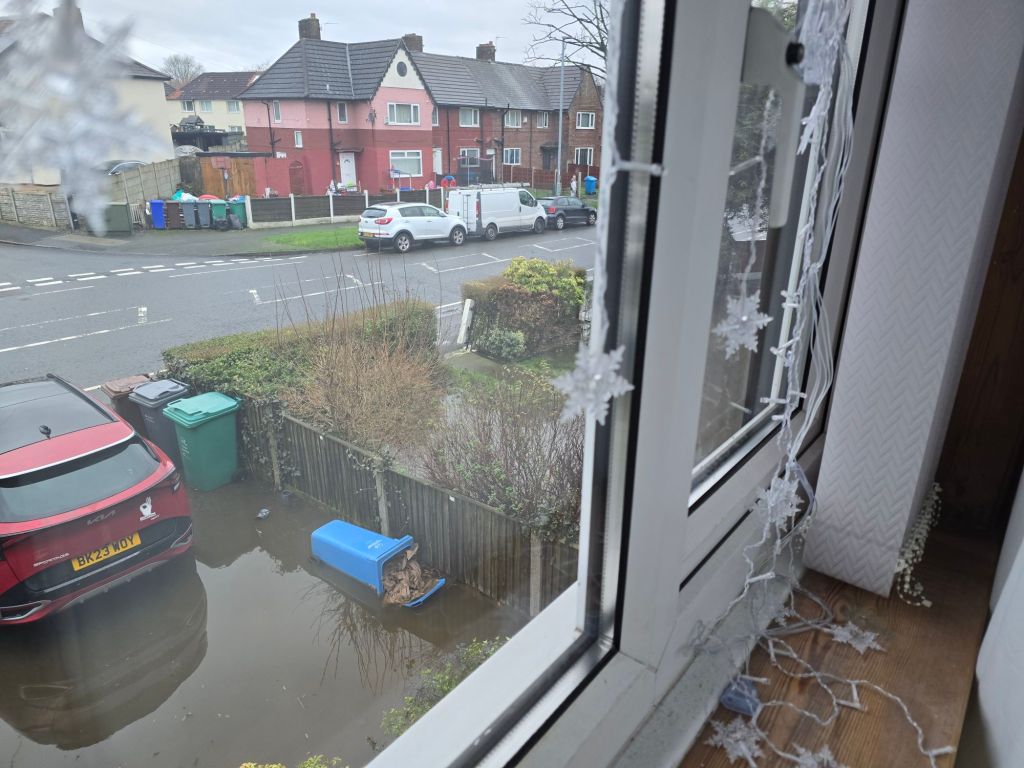
Sometime after 2330, we noticed the back garden was getting a bit water logged and the front too. My driveway was pooling, too. It had been raining all day, not heavily but consistently. An amber flood alert had been issued. There is a very small brook quite close but it’s normally just a trickle you could step in without noticing and this block of five terraced houses is slightly lower than the road, with the driveway dipping slightly close to the house.


The drainage on the road is pretty good. At no point did the road get waterlogged, but the house drains themselves were overwhelmed.

We sat in the house after midnight, watching the water rise higher and unable to do anything about it. My mum, aunty and uncle had a taxi booked at 0030, at that point they got damp but managed to get in the taxi ok. My brother and his partner left at a similar time.


That left me, my cousin Katy, who has cerebral palsy and is wheelchair bound, my cousin Lil, who is seven months pregnant, and my cousin Eddie, who has Downes Syndrome and walking difficulties. They were going to be staying overnight. It was becoming harder to see the water levels from the camera, so I briefly opened the front door. A little water came in, so I quickly shut it and put towels down, and they were immediately saturated.


I immediately told Eddie and Lil to get upstairs and cut off the electricity. Eddie paniced and had an accident, but we got him to the bathroom to safety.

Katy’s wheelchair is also electric, so Lil turned off the power to that too. Katy’s Labrador cross dog was on her lap. It turns out she’s scared of water. The water was now coming in from both the front and the back. We decided that Lil, Eddie, and Imogen should evacuate, so they ordered a taxi, which came quite fast.

The water was freezing cold and about 5-10 cm above our ankles at the deepest part. Lil got out with Imogen, the dog first. Imogen was very freightened and trying to jump on the sofas to escape the water, so she had to be pulled on her lead to get her out. Eddie was terrified, too. I held his hand and walked him through the water. There was debris. You couldn’t see the floor or where the step was, but we got him out.


My neighbours to the right were also flooded. They moved their car off the drive and were using the wheely bins to try and get the water to the street drain, barefoot.

I talked to the mum, and she said it’s never been this bad before and that her other neighbour was a vulnerable lady in her 80s, who she helped upstairs.

I went back in and called 999. It took 5 minutes for an operator, but they had to try 4 different numbers to get through to the fire service. It was actually West Midlands fire service, 100 miles away. Greater Manchester Fire service was overwhelmed. They took down the details, and I made it clear that Kary was disabled and trapped, and they said they’d pass it on.

Nothing happened for an hour. Katy is very stoic. She’s used to dealing with things going wrong and takes it in her stride. She tries to keep people around her that panic calm.

There was nothing we could do. We had no light other than these foam LED flashing light battons, some that were defiantly floating and flashing, plus plenty of glow sticks. My feet were freezing in the water, and she was worried about me, but there was no way I was leaving her alone downstairs.

We used a bit of gallows humour, filming the water and the floating glowsticks, and posted them with My heart will go on from titanic and the flood by take that to amuse outselves.


After an hour, I rang 999 again. This time, we got through much faster, and an engine was with us after 15 minutes! We were relieved.

The fire service came in, and they wanted to take her up the stairs, but Katy is dependent on her wheelchair. Taking her upstairs may stop her getting wet, but it would leave her 100% trapped and in pain. We weren’t happy with that at all.

They said it was too dangerous to evacuate her as they couldn’t see the bottom of the water in the front, and there was debris. They were worried about dropping her and any harm coming to her.

They were also concerned about what happened then. None of us knew the state of Katy’s chair. She normally gets to my house by tram or bus. She would have needed a specialist taxi with a wheelchair ramp to get home that way, and they are very hard to get hold of.

I remember one time when her mum was dying in hospital and we needed to get home in the early hours she was left stranded by the taxi firm so she and my aunty had to walk/roll to my mums house, a couple of miles away. Every little thing we take for granted, Katy has to struggle with, but despite that, she has managed to get a degree in teaching, I’m very proud of her. Her courage puts me to shame.

They weren’t keen on getting her out at all. Their message seemed confusing to me, telling her that she’s safe where she was but telling me to call the emergency insurance number to get put up that night as it wasn’t safe to stay.

I told them I’m not leaving without her. I asked about pumping the water from the driveway just enough so that they could safely get her out, but they said the water would just be replaced instantly, and there was nowhere for the water to go. I pointed out that the road itself wasn’t flooded and the drains were doing their job.

They may have been right, but they had to do something to try to get her out. Katy was in tears. They said that the water levels inside were receding and we should wait until the water levels were lower than the step then they’d come back to pump but when I asked how long they thought we were talking, they said that rain was still expected to carry on, it felt like we were being fobbed off, so they left after doing nothing.

We sat in the cold and dark, I put more blankets on Katy but it got to the point where I couldn’t feel my feet at all so I had to go up and take the sodden socks and shoes off and I fell asleep.


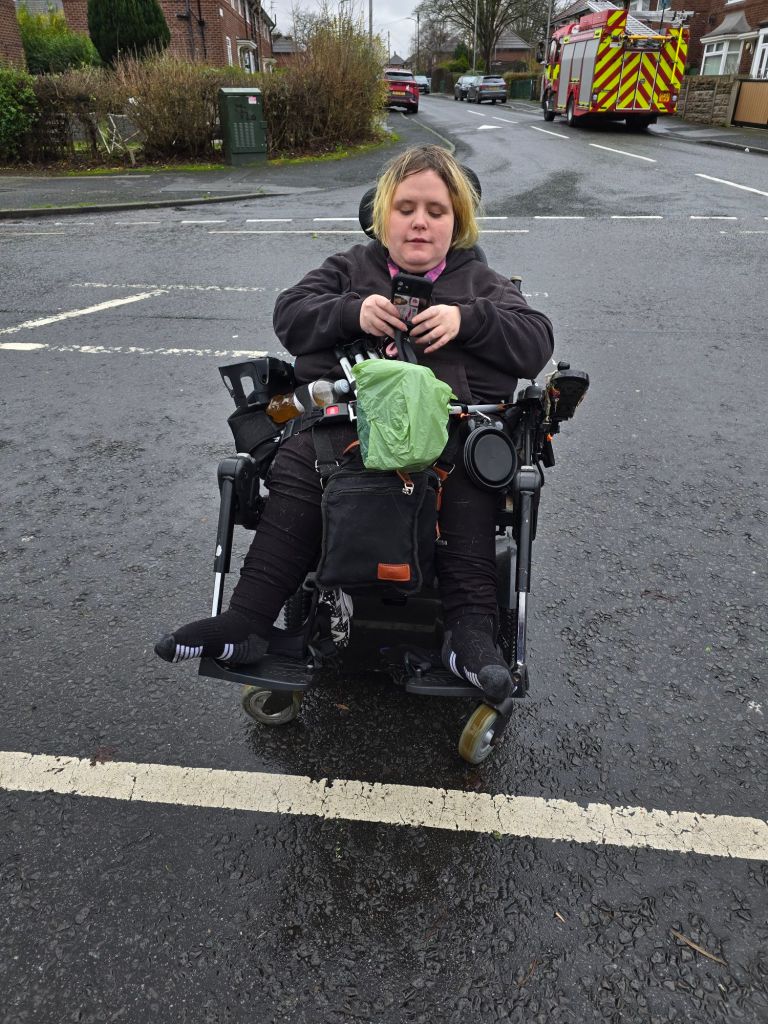
I woke up, checked on katy with my phone, and opened the curtains. The water level seemed constant and high but not rising. I was going to ring 999, but another fire crew pulled up outside my house. They had come to lift the elderly next door but one lady to safety. I went out and told the crew about Katy.

Their first suggestion was to lift her upstairs, but when I explained why that would make things worse, they listened, went in to talk to Katy, and analyse the situation.

It was an incredibly difficult situation for tbem. The hallway is narrow. Normally, Katy arrives through a guinell and into my house through my wider kitchen french doors. This route was not an option. By this stage, heavy parasol weights were just floating. The astro turf was floating, and the guinel was very deep.

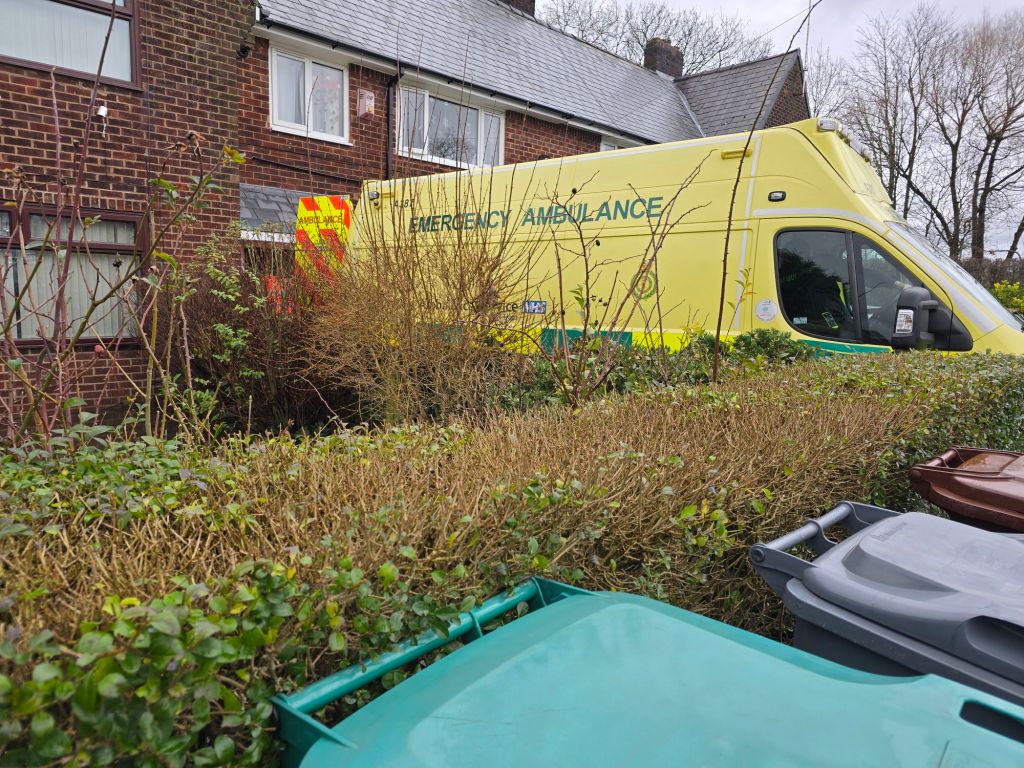
They managed to fish out Katy’s ramp, which had gone for a morning swim in the garden too. They devised a plan, organised an ambulance, removed an internal door, and restored the power to the chair. To our relief, it was fully functioning.They put chocks under the ramp to create a stable service, but then what happens at the end of the ramp?

They devised a plan to reverse the ambulance onto the drive and use it’s tailgate to extend the ramp, but first, I had to move my car out of the way.

My car has a unique party trick. I can start her up from the key and drive her forward or backwards without anyone in the car in a straight line. It’s great fun making people think they’ve seen a ghost as an empty car suddenly moves. It is very useful getting in and out of tight parking bays.

Anyway, so I walked my car over across the road to the rescuers amusement, the ambulance driver did a fab job getting in close enough for the ramps to meet and the fire crew pit extra support under the ambulance tailgait as they’re not designed to take the 300kg weight of the wheelchair. They made it work, got her in the ambulance, drove out of the water, and then assessed her. She was fine, so they helped her out of the ambulance on her duck approved chair.

My focus then shifted to my fish. I have a tropical tank and a marine tank, but without power, the water was way too cold. The tropical fish, in particular, were aggitated and dying. I lost all my shrimps and all but on glowlight tetra, managed to save 4 guppies and a few snails, into a jug, and I had a spare heater anyways.

Luckily, I recently bought a small 25l tank for quarantining, and I used this to rescue the marine fish. I save my pair of clowns, my firefish, my royal gamma, a bengal cardinal, 3 turbo snails, 2 strawberry conches, 1 cleaner shrimp, 1 fire shrimp and one of the two emerald crabs.

They don’t like their downsize, but they’re now warm and alive. The workman who’s done a load of house jobs for me helped me transport them to my mums. It’s only 1.5 miles, but we had to change routes twice to avoid floods, and the 8 million speed bumps (exageration) did not help.

Katy was able to make the same journey in her chair so now everyone is safe. I’m exhausted, I was already as I hadn’t slept, preparing the house for the party the night before (shouldn’t have bothered mopping).

Lots of people have been offering their help and support. My friend Lorraine came with hot flasks of drink and helped move my cousins car to safety. My friend Matt came to lend me his wellies and helped to secure my house.

I’ve been inundated with messages of support and offers of help, and I’m very grateful to you all. It is a blow, I don’t know how much damage has been done to the electricals. The water has receded now. There’s mud everywhere on the floor, but hey, nobody (human at least) has been harmed. Things can always be replaced. I will bounce back, and it will become one of those “remember that time stories.”

It’s not going to break my resilience. If anything, it’s given me even more appreciation for my cousin Katy and how she handles situations that would break most people!


Happy New Year, everyone! When I said I was thinking of upgrading to a bigger fish tank, this wasn’t exactly what I meant. Still, what doesn’t drown you makes you wetter….I mean stronger!

Why the British government are so keen not to tackle the increase in immigration

If you look back through the manifesto pledges of the two main political parties in the UK over the last 14 years, you will see that many of them have made promises to reduce immigration or strengthen border control.

2010 – Labour (Gordon Brown)
“Control immigration through our Australian-style points-based system, ensuring that as growth returns we see rising levels of employment and wages, not rising immigration, and requiring newcomers to earn citizenship and the entitlements it brings.”

2010 – Conservatives (David Cameron)
“Immigration has enriched our nation over the years and we want to attract the brightest and the best people who can make a real difference to our economic growth. But immigration today is too high and needs to be reduced. We do not need to attract people to do jobs that could be carried out by British citizens, given the right training and support. So we will take steps to take net migration back to the levels of the 1990s – tens of thousands a year, not hundreds of thousands.”

2015 – Labour (Ed Miliband)
“Immigration has made an important contribution to our economic and social life, but it needs to be properly controlled. With a Labour Government, migrants from the EU will not be able to claim benefits until they have lived here for at least two years. We will make it illegal to undercut wages by exploiting migrant workers, and work to strengthen integration within our communities. Everyone who works with the public in our public services must be able to speak English.”

2015 – Conservative (David Cameron)
“Between 1997 and 2009, under the last Labour Government, we had the largest influx of people Britain had ever seen. Their open borders policy, combined with their failure to reform welfare, meant that for years over 90 percent of employment growth in this country was accounted for by foreign nationals – even though there were 1.4 million people who spent most of the 2000s living on out-of-work benefits. For the past five years, we have been working to turn around the situation we inherited”

2017 – Conservative (Theresa May)
“Britain is an open economy and a welcoming society and we will always ensure that
our British businesses can recruit the brightest and best from around the world and
Britain’s world-class universities can attract international students. We also believe that
immigration should be controlled and reduced, because when immigration is too fast
and too high, it is difficult to build a cohesive society.”

2019 – Labour (Jeremy Corbyn)
“Our border security prevents serious crimes including child abduction, people trafficking, smuggling of drugs and guns, terrorism and modern day slavery. The Tories have further weakened our borders, cutting another 200 jobs over the last four years.

They have failed to deliver exit checks. In place of an effective border control they have required landlords, teachers and medical staff to work as unpaid immigration officers, creating a hostile environment. A Labour government will review our border controls to make them more effective.”

2019 – Conservative (Boris Johnson)
“That is why a majority Conservative Government will get Brexit done, and then introduce a firmer and fairer Australian-style points-based immigration system, so that we can decide who comes to this country on the basis of the skills they have and the contribution they can make – not where they come from. Migrants will contribute to the NHS – and pay in before they can receive benefits. Our new system gives us real control over who is coming in and out. It allows us to attract the best and brightest from all over the world.”

2024 – Conservative (Rishi Sunak)
“Illegal migration is unfair. It is unfair for people to jump the queue in front of people who play by the rules. It is unfair for taxpayers to pay for the hotels and public services. And it is unfair for illegal migrants themselves who risk their lives in the hands of people smugglers.

The Conservatives are the only party with a plan to stop the boats and reduce the strain that illegal migration places on our communities and public services. Labour have no plan and would grant an amnesty to thousands of illegal migrants.”

2024 – Labour (Keir Starmer)
“Launch a new Border Security Command with hundreds of new specialist investigators and use counter-terror powers to smash criminal boat gangs.”

Current Migration Levels Estimates

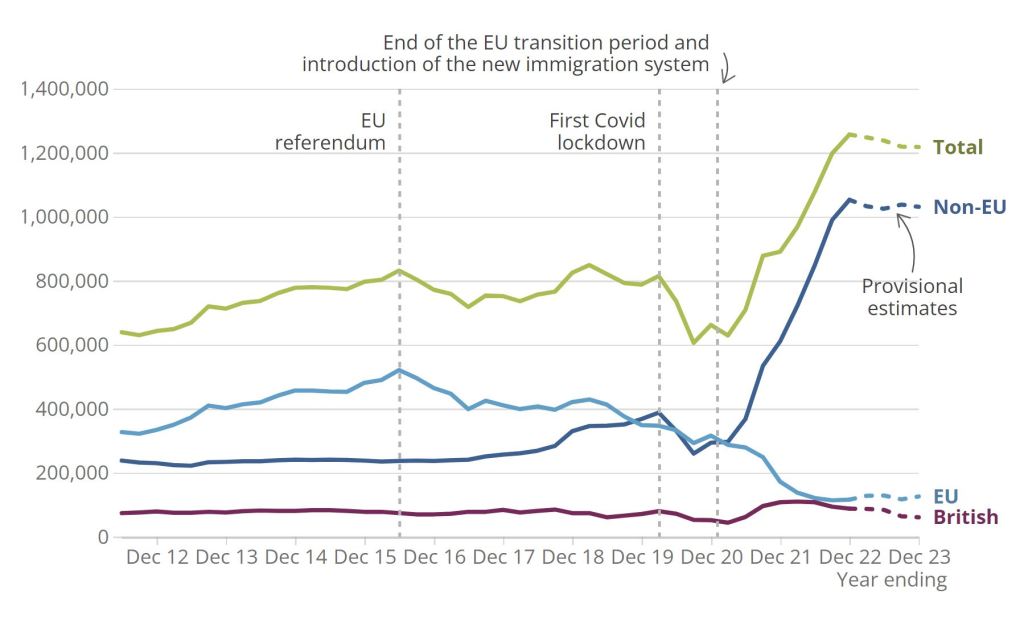
Data from the Office for National Statistics shows that over the same period, total legal immigration into the UK has been estimated to have risen from 639,000 to 1,218,000 with net migration (immigrants arriving less population leaving the UK) estimated at 744,000.

That is the equivalent additional population of a city the size of Nottingham arriving each year yet for the year ending March 2023 only 210,320 dwellings were built to completion in the whole of the UK and according to the 2021 census 1.1 million homes were already classified as over-crowed.

Illegal Immigration

In terms of migrants arriving by trafficking via illegal boats, the Home office keeps track of numbers of arrivals and boats that successfully make it to the UK.

YearMigrants ArrivedBoats Arrived
201829943
20191,843164
20208,462641
202128,5261,034
202245,7551,110
202329,437602
2024 **17,639343

* Data collated from https://assets.publishing.service.gov.uk/media/66b5e7e9fc8e12ac3edb0d41/08_Aug_2024_Small_boats_-_time_series_New_draft.ods.ods
** Data up to 08 August 2024

According to the Home Office, of the 129,407 initial asylum decisions received between 15 April 2023 and 14 April 2024, 93,431 were substantive decisions (56,834 grants and 36,597 refusals, which is a grant rate of 61%).
Home Office statistics published in February 2024 show that the accommodated asylum population (hotel population) on 31 December 2023 was 45,768. 

This is just migrants entering the UK illegally. In addition to this there are migrants that entered the UK with a valid visa but no longer have a valid visa.

Overstaying visas

The latest data available (published August 2020) stated that of the 1.9 million visas that expired upto March 2020, 91,612 or 4.8% were not recorded as having left the UK. However, this does not include non-EU nationals from certain countries that are allowed to stay in the UK for six months without having a visa. According to Migration Watch UK, this could be an additional 250,000 people per year.

Legitimate concerns

Many people are concerned about both the scale of immigration and community cohesion and whilst the data does show that net migration may just be starting to fall, many feel that successive governments have failed to address the concerns despite making promises to do so.

Why has immigration increased?

So why has immigration been increasing despite the promises to reduce it? Prior to Britain’s exit of the European Union, the freedom of movement guaranteed by EU member states to its citizens meant that the UK was powerless to control the numbers migrating to the UK from other EU countries, including new EU member states.

For the year ending December 2018, it is estimated that 424,000 EU citizens migrated to the UK compared to 342,000 non-EU foreign nationals. That figure fell to 151,000 EU nationals by December 2022, with non-EU nationals rising to 925,000. Source https://www.ons.gov.uk/peoplepopulationandcommunity/populationandmigration/internationalmigration/bulletins/longterminternationalmigrationprovisional/yearendingdecember2022

The reduction in EU national arrivals has been counterbalanced by a vast increase in non-EU migration. For the year to March 2023, 487,771 working visas were granted including 69,423 skilled worker visas and  101,570 Skilled Worker – Health and Care visas and 477,931 sponsored study visas.

A skills shortage?

The nature of these visas may be an indication as to what one of the significant factors in immigration numbers might be. A big skills shortage, particularly in health and social care.

According to Kings Fund, there were 111,000 unfilled vacancies in the National Health Service despite a 30% increase in staffing levels since 2009. Why do we need so many more NHS staff? The waiting list for Hospital treatment has grown from less than four million in 2008 to nearly 8 million in 2024. Hospital services are clearly not improving despite an increase in staff numbers. The estimated over all population has increase from 62 million in 2009 to 67 million in 2021 but even so, population growth can’t be the full explanation.

Demographic timebomb

When you drill down into the make up of the population, you start to see a bigger picture. Lets start with birth rates. In 1963 there were 18.3 births per 1000 people in the UK. By 2009 it was 12.524. It is currently 11.171. The average woman had 2.83 children in 1963 and now it’s 1.75. When the fertility rate drops below 2.1, that means the population is in decline, which has been the case since 1973 in the UK. Source. The same pattern is occurring in much of the Western world.

The combination of a larger ageing population that are living longer than ever before and a decreasing working age population is a demographic time bomb. For a welfare state to function, you need more people paying into the system than those using the resources provided but when a larger population ages and the younger population is much smaller, you have a big problem. Economically inactive immigration only adds to the burden but working migrants can be a benefit.

The migrants are needed to fill the gaps as older workers retire and to provide the complex care our ageing population needs. We need the skilled labour to keep services like the NHS running and we also need the cheap labour that keeps the costs of food and social care lower.

The government doesn’t want to tell you this because the consequence is that public spending will have to be cut including NHS services, pensions and benefits plus taxation may have to increase. The quality of life in the Western world has peaked and is on the decline.

Blaming the problems in society on levels of migration is actually quite convenient for governments, it keeps the focus away from a much bigger problem that is impossible to solve. If some people are using excessive migration as a scapegoat for their problems, the government is using them as a scapegoat for not being able to address the wider problems.

Having said that, the immigration concerns are not unfounded. It’s not just about the numbers, it’s about whom we are importing because there is a tendency to import issues from other countries. For example, there have been disturbances in the UK caused by large communities of Muslims and Hindu’s clashing in places like Leicester that mirror the tensions between India and Pakistan.

Extremist religious views and anti-Western sentiment is being imported into the UK. If left to fester, this is going to create more issues in addition to the issues such as inflation caused by the government devaluing its own currency by printing too much money in response to the 2008 crash and COVID pandemic.

We need immigrants that are economically active but we need to do a better job at vetting those that enter the UK and those already in the UK that despise British culture and values or our values will shift and become less liberal and less tolerant of others. It’s going to become harder as more young people become disillusioned with life and feel that they do not have opportunities to improve their circumstances. Young people without hope are much easier prey for extremists that will offer a pre-made excuse and a non-peaceful solution. We must be careful not to alienate young people with polarised rhetoric that drives them to violence, be it anti-Muslim sentiment, anti-Jewish sentiment, or even climate extremism for that matter.

Stopping people trafficking might not do much to the UK population over all, but it will make people feel heard. Deporting foreign criminals and applying the rule of law equally to all communities will help too.

My dystopian fear is that the ideal solution for Western governments would be some kind of virus that wipes out large sections of the elderly community without touching the younger generation. In the past their has been an alignment between mass unemployment and war as it conveniently creates employment and reduces the working age population but this time it’s a lack of younger people that is the problem.

Perhaps if we had a government that incentivised families and reversed the trend of lower birth rates, eventually, the population could recover.

Can we have a nuanced discussion on racism?

Yesterday I wrote a piece about the riots off the back of the murder of three children in Southport. I talked about how the media and the government have been irresponsible about labelling all the protesters (please note, I make a distinction between protesters and rioters) as far right thugs. It’s not really helpful, it only adds to the polarisation rather than addressing people’s genuine concerns.

However, I don’t think it’s a good idea to just look at complex societal issues from one perspective, I want to add some nuance. Imagine you’re a young British Muslim. You work hard in the gig economy just to make ends meet. You contribute to society and just want to live your life in peace. You’re not an Islamic extremist but when you’re out in the streets, sometimes you get that look from people as if you’re about to blow them up. It must get very frustrating and make you a bit fed up and disillusioned.

Some terrible murder occurs and automatically people jump to conclusions and assume it’s an Islamist terrorist. Racist thugs make a beeline for the nearest Mosque and try to antagonise you. They are threatening your family. They are making you feel unsafe in your own community and they make no distinction between decent, honest peaceful people like you and nut jobs that hate you and consider you as infidels just as much as they hate none Muslims.

It’s not nice, is it? It’s going to make you a bit angry and defensive, isn’t it? In the press there are lots of people calling out Islamic Extremism and complaining about a lack of integration and demanding a response from the Muslim community. It’s collective guilt. Suddenly everyone who looks a bit Asian is fair game yet you’re told you should be mixing more with people that clearly hate you. You were born in Britain, you don’t know any other country but somehow you’re not welcome and told to “go home” on your own streets.

I can empathise with that feeling. I’ve experienced it myself from another context. Whenever there is a female victim of a horrendous violent crime like rape or murder there are protests calling for men, as a group to be curfewed. Half of the population is labelled as “a problem” and told they must do something about a small minority of criminals that think violence is acceptable. Collective guilt and shame doesn’t solve anything, it just hardens people’s opinions, creating an “us” group and a “them” group.

This is why I wrote that article yesterday in the first place. The media were creating an enemy group and collectivising lots of people from lots of different backgrounds as “the far right”. It’s no different from labelling all Muslims as terrorists or all men as potential rapists.

I think we need to understand human nature if we want to improve things. A lot of the things that we do are driven by a portion of our brains that we share with nearly all mammals. Humans are just one species amongst many fighting for survival in the natural world and we have these instincts to fear people different from ourselves because those mammals that developed those instincts were less likely to be eaten by predators, be it from the same species or other species. It’s a survival instinct that has served us well in many ways but this tribalistic behaviour doesn’t help in a modern world with larger populations living together side by side.

Racism is not something that white people do and darker skinned people are the only victims of. It is not about an oppressor class and the oppressed. It’s a fundamental feature of human nature, all nature in fact. It’s something we’ve all got in common. When I say this some people are going to see it as an endorsement of racism and that’s not the case. Stating that something “is”, is not the same as saying that something “should be”.

The great thing about human beings is that we’re an incredibly adaptable species with neuroplasticity. We can’t erase our “lizard brains” but by understanding what is going on, we can work around them. The only way to stop any form of discrimination against another group is to stop categorising people into another group. We have to look for what we have in common, which often is much more than that which divides us. When we stop seeing one group of people as bad, and our own position as entirely virtuous and justified, maybe then we can bring people together.

We need to tolerate our differences and try to understand them. I’m not talking about tolerating thugs trying to burn down Mosques or extremist religious zealots calling for slitting the throats of anyone they deem to be inferior. I am not calling for the appeal to moderation fallacy, whereby we automatically assume the truth is somewhere in the middle, because it’s not. What I’m calling for is to take the heat and the emotion out of situations and try to imagine what the world looks like from other perspectives than your own and use our empathy to relate to that person. That’s how you stop people becoming more extreme.

Don’t bother trying to argue with those that are already too far gone. Those that want to legitimise violence against other people or groups. They do exist, and they’re poisonous, but also lets not assume that the extremes are representative of the majority either. The hand of friendship between people with very different opinions will do more to create peace than any protest, any angry rant.

Let us take the example of Daryl Davis, the black American blues musician that befriended members of the Ku Klux Klan. By listening to them and making them feel heard he disarmed their hatred and persuaded hundred of members to change their attitudes through dialogue. Read more about Davis here.

That is how you do it, not “anti-racist” placards or organisations like “Hope Not Hate” whipping up fears with their lists of non-existent far right protests. Not calling people fascist or racist or “far right”. The simple art of getting people together and having a chat, getting to know each other. De-escalating tensions, not pouring petrol on them. No weapons, no face masks, no banners or chants. Just talking and giving each other the benefit of doubt. If that person responds with violence, walk away.

I’ll leave you with my favourite quote of all time from Fredrich Nietzsche

“Whoever fights monsters should see to it that in the process he does not become a monster. And if you gaze long enough into an abyss, the abyss will gaze back into you.”

Can we have a sensible conversation about the riots

Before I begin, I want to make it very clear that there should be no place in society for violent thugs looting businesses, destroying property, attacking the emergency services and committing arson. I don’t care what your cause is, whether it’s climate change, protest about wars in the middle east or crimes committed in the UK. Violence is never the answer. Those that have committed these crimes should be punished according to the law.

Secondly, I understand that there is an element of our communities that don’t understand the difference between various groups of immigrants such as first and second generation immigrants born and raised in the UK that are here legally, that provide crucial skills that we need in the UK like doctors, nurses and engineers. Without these people contributing hugely to our society we wouldn’t be able to function as a country. There are also people fleeing from war torn countries that are in the process of claiming political asylum to gain refugee status and finally there are people that have been human trafficked across the ocean in incredibly dangerous vessels that run the risk of losing their lives. This is a human tragedy. Our media, our politicians and members of the public on all sides of the political spectrum conflate these groups, often maliciously.

There are people that believe that trafficked illegal migrants and are simultaneously coming over here, “taking our jobs” and not working, receiving generous benefits and being handed priority council houses whilst British people of all ethnicities can’t find work or affordable housing. This is absolutely not true. Those that survive the journey are often at the mercy of criminal gangs and exploited in industries such as farming, fishing, or sex work. These illegal migrants were sold a dream by criminal gangs but that dream has now turned into a nightmare.

I do not believe that the majority of the people that hold misguided views about illegal immigrants are bad people. I don’t believe they are fascists or members of the far right. They’re just people living in communities where there are genuine issues with poverty, social cohesion and an influx of migration that is having a negative effect and they feel they are not being listened to.

Successive governments have made promise after promise to control the flow of illegal immigration and reduce the flow of legal migration to manageable levels but those promises have all been broken. People are frustrated and angry. They feel like their culture is under threat, and they are correct.

The knife murder of three young girls in Southport felt like the final straw for a lot of these people. There was a vacuum in terms of information about the identity of the culprit and where there is a gap, false information quickly spreads. Some of the rioters believed that this was yet another extremist Islamist terrorist in the footsteps of the 7/7 London Underground attacks, the murder of Lee Rigby, the Manchester Arena bombing amongst other similar incidents. Of course, in this case they were wrong. I do not know the motive of the killer. It could be a case of mental illness, a personal vendetta or terrorist grooming of a young man to hate the country where he was born.

Whenever children are murdered, it always provokes an emotional reaction. There were protests when Holly Wells and Jessica Chapman were murdered. There were protests when Jamie Bulger was killed. There were protests when Sarah Everard (although not a child) was murdered. Grossly offensive murders tend to trigger deep fears. That is no justification for rioting but just as one side of the press and public discourse encourage hatred based on fears around immigration and lawless streets, the other side of the media likes to whip up hatred by labelling anyone upset over the deaths as “far right”.

There used to be a time when people could hold different opinions on different subjects, debate vigorously but at the end of the day still enjoy a drink together and recognise the humanity of the other person.

We seem to have lost that. You’re either with us, or you’re the enemy and we’ll use caricatures of what we believe the other side is saying and portray them as racist because an ad-hominem is easier than nuanced, balanced discussion. It may make people feel good but it won’t re-educate people that have a false impression of the situation and it won’t address the legitimate concerns that have been ignored for decades.

Yes, there absolutely are a small number of people that genuinely hate anyone of a different skin colour or religion to them. They exist in the Muslim community. They exist in the White British community. To be honest, they exist in every community. When the police use heavy handed tactics for one group of protesters then walk away in other instances, it’s like throwing petrol on an already burning police car.

The Prime Minister’s response was tone deaf. You can’t keep calling everyone who has noticed that the Emperor isn’t wearing any clothes “far right”. For the majority of the protesters, it wasn’t about race. There were Sikh protesters, Black protesters, even Chinese origin protesters. They are all fed up with a lack of law and order and two tier policing. We’ve turned a blind eye to the issues with communities that refuse to integrate and that refuse to obey the rule of British law. This is not all Muslims. There are plenty of British Muslims that have integrated and enrich our communities and these people do not deserve to be attacked by thugs in guilt by association but the rate of influx from countries with very different value systems is causing problems. We need to reassert British values such as tolerance, justice and peace.

There seems to be this bizarre alliance between far left communist groups supporting groups that are totally illiberal. Extremists that do not believe in gay rights supported by LGBT organisations. People that want to curtail the right to free speech, the right to criticise Religious groups. I don’t think they realise that the spider is not keeping them on the web to invite them to supper.

We need to stop the influx of cheap labour that is keeping down wages in the UK at a time when the cost of living has never been higher. The media is the boy that cried wolf. You can only claim that all the disgruntled British people are racist far right thugs for so long before it ceases to mean anything. The scary thing about this is by that behaviour we are becoming completely desensitised and that creates an environment where that small handful of genuinely racist odious cretins in the real far right might become much more appealing to disillusioned young people that see very little hope for the future. Is that what we want?

It’s time to cut out the rhetoric. Stop this divide and conquer smoke-screen aimed at distracting us from the reality of falling standards of living, increasing poverty and unrest. People of all colours, ethnicities, faiths and socio-economic groups. We need to unite together and make it very clear to anyone trying to pedal lies to make people believe that Britain is a country full of racists that this old tactic won’t work anymore. We want to preserve our values and we will peacefully put our point across until the establishment starts to listen.

Stop the mass gaslighting of the general public. Stop pretending there isn’t a problem with community cohesion. Actually police our borders and stop the torrent of criminal gangs trafficking vulnerable people to this land. Enforce the law equally for every citizen and lets innovate to build a better economy, a stronger economy of substance, not bluster.

When we, the people, speak as one, we demand the government we have elect to power to serve the people, not belittle them.

Flying fat: My experiences expanded

In December 2022 I wrote an article in response to a published piece in the mainstream press about a man forced to pay for two seats on a flight. Since then, I have been fortunate enough to fly abroad a couple of times and each time I’ve encountered some problems relating to booking seats.

It’s a fairly niche issue. Most people don’t have to worry about these kind of things when they go travelling but sadly obesity is a prevalent issue in Western countries so the chances are that more and more people will experience these kinds of issues in the future, especially with the trend amongst airlines to cram as many cattle, I mean passengers, onboard as possible to maximise revenue.

Not that I blame airlines for trying to maximise profit with smaller seats. It’s very difficult to make a profit as an airline given the number of issues they face with rising costs of fuel, taxes, intense competition and the sheer logistics of air travel at a time where demand outstrips supply for qualified pilots, take off slots and the aircraft themselves.

As sympathetic as I am to the unique challenges the industry faces and how enthusiastic I am about the privilege of widely available air travel, I do think this is an issue the industry can and should do better with for the benefit of all passengers regardless of size.

First of all, I want to make it clear that I’m not an activist demanding special treatment for fat flyers. I am quite happy to pay an additional fare for an additional seat in the interests of my own comfort and the comfort of other passengers, even if that means the extra cost results in fewer opportunities to indulge in my passion for aviation.

I know some people think that larger passengers shouldn’t be allowed to fly at all but their position is just as extreme and ignorant, often pronouncing fears of planes falling out of the sky because they’re overloaded when the chances of this happening with a modern jet airliner are nil. Lithium batteries in vaping devices are a far bigger threat to aircraft but there’s no clamour to ban vapers from travelling.

I think passengers should be considerate of other passengers and I completely understand other passengers boarding a plane, seeing someone of a larger frame and hoping that they haven’t drawn the short straw and ended up sat next to the larger passenger. I know that look. I can see what you’re thinking and I understand. I wouldn’t want to be sat next to another “person of size” either, which is why if I’m flying alone, I always book an additional seat unless flying in business class or above.

What the general public are not quite so aware of is how difficult airlines make it for obese passengers to be able to do just that. I’ve yet to find an airline in Europe that makes it easy to book two seats for one person. It’s easier to book a seat for a Cello than it is to request an extra seat for the comfort of yourself and fellow passengers. I’ve flown with RyanAir, easyJet, Lufthansa, TUI, British Airways and Jet2. The situation may be different in other parts of the world.

Airlines want you to use their online systems but when you book online, if you try to put the same passenger name and passport number down, either at the time of booking or checking in, the systems think it’s an error and often make booking online impossible. Some airlines have specific work arounds, using the passenger name “Comfort Seat” for example, but finding out that information is really difficult. It is rarely listed on the airlines website anywhere.

If you are lucky, you might find a paragraph hidden deep in the terms and conditions advising passengers that they need to book two seats if they need a seat belt extender, but they tend to stop short of actually telling you how to do this. You either have to find a random aviation forum somewhere or you have to ring up the airline. The online chat services just tell you to ring the sales number.

When you ring up, the staff are often confused and think you’re trying to book an “extra legroom” seat and they often don’t know the airlines own policies because actually, most airlines prohibit passengers that need a seatbelt extender from sitting in exit row seats as you need to be able to assist with opening of a door in an emergency. The bulkhead seats or first row seats often have a different type of seat that have fixed arm rests so they’re not suitable either. To be able to book a suitable seat you need to have intimate knowledge of the configuration of seating on board a particular airliner and even within the same fleet, that can be different for the same type of aircraft. It would be nice if airlines at least published the seat pitch, type of arm rest and any regulatory restrictions on the seat selection screens of their booking systems rather than take your money and leave it to the airport staff to have that awkward conversation.

Some airlines use special seatbelts with in built airbags in business class and these cannot be used in conjunction with seatbelt extenders so even a business class seat is not guaranteed to be suitable for larger passengers. The utility of such seatbelts in an emergency situation is more likely to hinder a passengers escape than help so I wish airlines would stop using them.

After explaining the situations a few times to the perplexed sales operative, you might eventually be able to book two seats together, often at an inflated price per seat as booking via the phone is often more expensive than booking online. You will also need to pay the seat reservation fee to guarantee that your comfort seat is actually next to your other seat. It can sometimes cost three times the price of booking a standard seat once you factor in all the additional costs.

Having gone through all that additional hassle to purchase your seat, it’s now time to check in for your flight. You try to check in online, just how the airline want you to. For most airlines though, you get the same validation issues with booking online. You contact the support number. They don’t know how to handle the situation so they tell you to check in the old fashioned way at the airport. There may be an additional charge for airport check in too, although in my experience, it’s normally waived.

You go to the airport and try to explain the situation and it’s pot luck whether the operative knows what to do. There have been occasions where it has taken an hour for the airline to work out how to check me in, involving supervisors and multiple calls to head office. Other times they will tell you everything is fine and that you are checked in.

You board the plane, everything seems fine. It’s a packed flight and right at the end of boarding, another passenger appears on the plane and is allocated to the seat that you have paid for. In that situation, you could kick up a fuss and explain to the cabin crew that you paid for that seat too or you could just keep your mouth closed and sit with your arms folded, trying to minimise the amount of room that you’re taking up. You can see the staring from other passengers and you can tell what they’re thinking, “He should have bought two tickets”. “Inconsiderate b**tard”. It’s not a nice feeling. Alternatively, you could mention it, but as the flight is completely full, the only option would be to offload one of the passengers, which would delay the take off for everyone else whilst any hold bags are found and removed and that could cause even more drama and angry looks from other passengers.

This was the choice I was presented with on my last flight. I chose to keep quiet and luckily, the late boarding passenger, who wasn’t actually scheduled to be on that flight originally, was a small female passenger. I felt bad for her having to sit next to me for two hours but she was just relieved to have gotten on the earlier flight and made no fuss about the lack of room. It could easily have been a more hostile situation if the other passenger was of a larger frame.

As far as I was concerned, I’d gone out of my way to do the right thing, to consider other people, to book an extra seat at significant expense and inconvenience and still, my purchased seat was resold to another passenger because the airlines system wasn’t clear and the airline staff in the airport didn’t read the notes in the system. It’s very frustrating and it’s completely unnecessary.

Last year, my flight returning from Portugal was cancelled at 5pm the night before I was due to return with little explanation. By doing my own research on Portuguese news websites, it turned out it was the result of strike action by the airlines flight crew and was known about at the time of booking. There were no alternatives flights to my local airport from our destination airport. I had two options. Either fly to an airport hundreds of miles away from home and find alternative transport at the other end or fly from a different airport a few hours drive away from where we were staying in Portugal to my home airport.

I opted for the latter, and hastily arranged to change the drop off location of my hire car at considerable expense, but the rebooking system couldn’t show whether the two seats I had purchased would be together. I had to find the same flight via the airline website and pretend to make a booking so that I could see the seat plan, and if there were indeed two seats left together. There was only one suitable row. I booked the seats then I had to pay to reserve the specific seats together again, even though I had already paid for the seat reservations on the original flight. It was a nightmare, but in the end, I got home safely on the same day I was originally meant to fly and I got the two seats together that I had paid for.

I tried to claim back the cost of having to change the car hire drop off and the cost of the additional seat reservations but the claim was rejected on the basis that the invoice didn’t make it clear that the cost was not for the original car hire agreement, just the additional fee to change the drop off and there was no way to provide additional information or challenge the result of the claim. In the end I put a separate claim in for the cancellation of the original flight and received the full airfare back for both my seat and the additional seat, which was hundreds of pounds more than my original claim only covering the difference in travel expenses I had incurred as a direct result of the cancellation so the airline cost themselves money by being unreasonable with the original claim.

What I would like to see going forwards is consistency between airlines. I’d like them to make it clear up front when booking seats that passengers that need an extension are required to book two tickets. Not every passenger is diligent like me and considerate of other passengers. Some obese passengers chance it and hope they’ll be allocated an extra seat for free at the airport.

I would like to see it made easier to book a comfort seat, even if it’s at the same cost of the first seat, you should be able to do it online without having to ring up and the check in systems should be updated to automatically check in the second seat. This would create an end to the needless conflict and errors caused by a system that isn’t designed to cope with the needs of bigger passengers or passengers with other needs that might mean they need a bit more room such as a broken leg.

Make it easier for bigger passengers to do the right thing and then everyone benefits. We won’t have passengers squashed next to a bigger passenger, creating discomfort and animosity towards fellow passengers and we won’t have the embarrassment and humiliation of bigger passengers either. Everyone wins! Airlines have enough problems with situations completely outside of their control so anything that can increase customer satisfaction with minimum effort surely would be a good thing!

What next?

Sometimes we reach a cross roads in life, when everything feels uncertain. That’s where I am right now.

Like many people, my identity has always revolved around what I am to other people. Whether it’s the friend that could make you laugh (or cringe), the sweet romantic husband, not afraid to show his affection or the hard working, enthusiastic person I was in my career. Now, everything that defined who I am for so long is up for grabs. OK, I’m still the guy with the bad puns, but everything else is different now.

I have to remind myself that I’ve been here before. When I was 18, I quit college after suffering from a bout of depression. I was ghosted by my girlfriend at the time. I did a dead end temporary job stuffing envelopes and filing paperwork. I had no direction. It was just about getting through the days.

Still, I bumbled along through life, managed to get a permanent job and another girlfriend. A girl that I’d spend the next twenty years with. The job gave me a sense of purpose and rekindled my desire to learn. Hiding underneath the darkness of depression was someone curious about the world around him, enthusiastic about learning and determined to make a better life for myself.

That’s exactly what I did. I liked technology. I was fascinated by how I could press on a little piece of plastic and somehow pixels would appear on a screen. It wasn’t my first love. As a child I wanted to be a writer or a politician, but with terrible handwriting and a shy nature, I couldn’t see a path through.

I started looking through university prospectuses for inspiration. Computer science sounded interesting, it sounded creative, so I got in touch with the University and asked them how a college drop out like me could get in. I did an access course. It was very difficult balancing college, working and being a carer, but at that time in my life I was absolutely determined and full of confidence.

It coincided with the first time I managed to lose a shedload (technical term) of weight, getting down to 12st 8lb. I never do things by halves. I seem to be an all or nothing kind of person. I also learned how to drive. College was easy. I was like a traveller in a desert that had just been given a truck full of water (the sheds were too porous). It was an unquenchable thirst for knowledge.

Uni was much more mixed. I did everything they told you not to. I would concentrate on my strong subjects, investing huge amounts of effort in the subjects that interested me the most, breaking course records as I went and I would just about scrape through the modules that didn’t interest me or involved too much maths. I left things to the last minute but I seemed to have the ability to cram in revision or assignments and I got through. The strong grades papered over the cracks of the weak subjects.

It wasn’t easy. In fact, I nearly gave up. Balancing working, caring for mum, being a boyfriend and uni took its toll on my physical and mental health. Something had to give. I was putting the weight back on fast and had to take an interruption to my studies. Six months later, after a freak accident involving the worlds most unreliable Fiat Cinquecento, I hurt my back. Being a stubborn man, I ignored the pain shooting down my leg until one day it went into full spasm and I spend a couple of nights in the MRI on morphine, unable to walk. I had a slipped disc and sciatica.

After 18 months out of Uni, the future looked bleak once more. I dropped out of college and now it looked like I was going to fail at Uni too, but I didn’t. I kept on going. I spent more time in my second second year trying to sort out an industrial placement than I did on my actual Uni assignments. I knew how important it was going to be to get industrial experience. I went to interview after interview. Always getting selected for the second stage but there was one role that stood out. An agency that was made up of former placement students that had done well.

I took my chance, wrote a covering letter mimicking the companies own website in a move that stood me out from the plethora of other students. I got in, but at some cost. Not only was the placement a pay cut but the agency wanted a software engineer and a designer student and they’d already got their engineer. Design was not my skillset at all, I can barely draw a stick man but they took a punt in me.

At first I struggled. I remember being called into a meeting room one day and fearing the sack. Things weren’t going well. I’d gone from being one of the brightest students at Uni to really struggling. I didn’t get sacked. I carved a niche for myself. My role was part tech support, part dealing with customers and occasionally writing a bit of code. I made myself important to them and by the end of my placement, they wanted to keep me on and were willing to pay my student fees to switch to part time at uni. That’s why it ended up taking me 7 years to finish my degree.

In all honesty, I don’t know how I got through. I was burning the candle at both ends. Sleep was very much optional. I got through, I graduated and graduated with a first and I had a career. I learned from people that were a lot smarter than me and a lot more natural engineers, but with my willingness to learn, I progressed and got quite good.

I watched the company expand. I was there when an entire room full of software developers lost their jobs when funding for a big project was pulled, I survived but the writing was on the wall and after 7 years at that company, I moved on.

That was incredibly scary for me. I don’t really like change. Moving on was a risk, but it paid off. I was earning more money than I ever had. I was enjoying the camaraderie with my new team mates. I felt part of something. I was performing. Life was good. Then the pandemic came and over night everything changed. I didn’t like the isolation of working from home. There was a lot of turmoil going on and where once there was enthusiasm and excitement for learning, now there was fear of not being good enough.

I felt like an imposter, that it was only a matter of time before I was found out. I felt like I was about to lose everything, and actually, I did. I somehow still have a job but it’s no longer a job that brings me joy. I invested so much to get into this career, so now what?

At the age of 41, I don’t know who I am any more. I don’t know what I want to do with my life. I don’t know if my current malaise is something I can work through and come out the other side, back to being the Jon that used to make Christmas cards in Visual Basic and simple games. If not being a dev, then what else can I do?

The chances of making it as a writer are negligible. It won’t pay the sky high mortgage and energy bills.

I don’t even know where to start. I’m not a twenty year old with time on my side anymore. I know that the only person that can make my life better is me, but I don’t know where to start.

Well, that’s not entirely true. I do know where to start. I’ve been neglecting my physical health for too long. I have tried and failed many times to lose weight and keep it off but this time it’s my number one priority. I’ve set myself goals and this time there’s no crazy shakes or unsustainable diet. I’m not looking to change everything over night. Just one small change at a time. Not a temporary change to hit a target but a permanent change to my relationship with food. Hopefully as I lose weight, as I set realistic goals and achieve some of them, it will give me the confidence to sort out the rest of my life.

The fear of failure has had its claws in me for too long. I believe I do have a purpose, even if I haven’t found it yet. There’s got to be a meaning behind all this. I know I’m at my happiest when I’m helping others. I need to find a way to do that.

I don’t want my identity to be Jon the loser (unless you’re talking about weight), Jon the quitter, Jon the failure, or Jon, the depressed guy. I want it to be Jon, the guy that makes people smile, laugh, think or feel something. I can’t do it alone. I’m going to need my friends and family to help me every step of the way, to believe in me and encourage me.

This is my Everest, but I can’t climb it on my own!

Weight loss surgery on the NHS

Today I had my 4 in 1 assessment for bariatric (weight loss) surgery with the NHS.

In order to qualify for weight loss surgery on the NHS, you have to have a BMI over 35, although it can be lower if you have other comorbidities. However, the exact requirements vary from NHS Trust to NHS Trust.

You can’t be referred directly for weight loss surgery. Your GP has to first refer you to a special Tier 3 weight management programme that includes information sessions on various subjects including nutrition, emotional eating, exercise etc.

In my case I did my programme with a company called More Life, starting late July 2022, having asked my GP to refer me for the programme in February 2022. For the Tier 3 service to refer me on for surgery, I had to lose at least 5% of my body weight, I had to attend 80% of the sessions and also participate in at least two bariatric information sessions.

My start weight at More Life was 34 stone 2 pounds and by the time I was referred for Surgery in March 2023, I had got down to 31 stone, meaning I lost 9.2% or 3 stone 2 pound. Once referred for surgery, you are discharged from the weight management programme and expected to fend for yourself until your first appointment with the surgeons. For me it was a 13 month wait and when the appointment came, it was completely out of the blue, a telephone call that I nearly didn’t answer as I normally ignore private numbers.

In between the weight loss programme finishing and now, an awful lot had happened. I ended up in hospital last May with what turned out to be a blocked bile duct caused by gallstones. The doctors told me that I should have my gallbladder removed, but the surgeons would be unwilling to perform that operation because of my size.

By July 2023, I got down to 28 stone 10, but subsequently went through a nasty separation, divorce and bought a house. It was an incredibly stressful time and my diet gave way and I was worried this would effect my referral.

When the appointment to see the surgeons was made in March, I had regained 1 stone 10 pounds. I immediately got back into action and by the time of the appointment today, I was back to 31 stone 3 pounds.

I was pretty frustrated and disappointed in myself that I had put on so much weight, but at the time it was just a case of “survival mode”. If it wasn’t for the appointment, I would have continued to struggle. Having that appointment coming up was key to re-motivating myself, and going back to the good habits I’d gained during the weight management program.

When the appointment was booked, I was given a booklet to read, a check list and also a link to two videos to watch. I was also asked to join a Teams session with the Dietician and lead nurse. That provided me with the information about what to expect for today’s session. I was expecting to get a grilling, testing my knowledge about the procedures, the pre-op Liver Reduction diet and the post op diet etc, but that didn’t really happen.

Parking at the hospital, Salford Royal was a nightmare. It took me 40 minutes just to get into the car park. Luckily I set off 90 minutes before my appointment for a 30 minute drive, so I was still on time.

I walked straight past the clinic at first. It’s the Diabetes / Endocrine centre. Once I found the entrance, I was given a form to complete, a consent form for the Bariatric register, then asked to sit in the waiting room. The waiting room was packed so I stood outside it but within 5 minutes, I was called in to be weighed, then had some bloods taken. The staff were very friendly.

Then there was another wait, this time much longer. I was introduced to Professor Syed whom went through my medical history with me. One of the prerequisites for bariatric surgery is a sleep assessment. This is because people my size often have a condition called sleep apnoea, which means the airway is impeded during your sleep, preventing breathing, so your body wakes you up to catch a breath. They need to know if you have this as it impacts the anaesthetic treatment in surgery.

More Life told me to get my GP to refer me for a sleep study once they referred me for surgery. My GP referred me, but the sleep clinic initially refused their request. I had to complain again to my GP. They referred me a second time and I was given an appointment for February 2024, but in January, the appointment was cancelled with no explanation and no new appointment provided. In March I got a text message asking me if I still wanted to remain on the waiting list for the sleep study. I explained all this to Professor Syed and he referred me again, but from what I can gather from the patient forums, I could be waiting 6 months.

This is an issue because you don’t go on the waiting list for surgery until all investigations are completed first, and the waiting list for surgery is currently 12 months, so we’re talking another year and a half before I am operated on.

They also offered me weight loss injections in the meantime. I have been asking for these injections ever since they were first authorised by NICE, the organisation that controls what medicines and treatments can be made available on the NHS. The first time I asked, there was a national shortage and nobody was prescribing them.

I asked my GP again last summer. My GP took bloods and I was denied the injections because my blood sugars were normal and my cholesterol was good. I felt like I was being punished for losing weight already.

The injections work by suppressing the production of the hunger hormone Ghrelin, which means you don’t feel as hungry, making it easier to stick to a healthy diet. Weight Loss Surgery itself does the same thing, except to a more extreme extent.

Two months ago, I decided I couldn’t wait any more and got a private prescription through boots online doctor. It costs £199 for 4 weeks. I couldn’t really afford it, but I did it anyway and asked the GP if the situation had changed. They told me that only weight management programs could prescribe them. So, to be offered the injections by the hospital was a relief.

To be honest, I haven’t really felt any difference in terms of appetite so far on the injections. This may change as the dose increases as you start on a very small dose and increase each month. The big thing for me is routine and planning. I force myself to have breakfast, so I’m having two meals a day.

They made it clear that they don’t offer these routinely to every patient, but in my case, they really need to help me get my BMI down to about 55 to make it safer to perform surgery. The disadvantage is that whilst I’m being treated with the injections, I don’t count towards the waiting list.

I’m not a morning person and I don’t tend to feel hungry in the mornings so I always used to skip breakfast. I’d also skip lunch too as I developed a phobia of eating in front of other people that started after a classmate made a comment about the fat kid eating chips on my first day in high school.

My body is used to starving through the day then binging at night. I have to make myself eat breakfast to break the cycle. I also plan my meals out in advanced now. At the weekends I cook my proteins so it never takes more than 20 minutes to prepare a meal each evening. I either have 3 eggs or 2 chicken breasts or 2 lean pork loin steaks together with plenty of vegetables and a controlled portion of either brown rice, wholemeal pasta, a baked potato or mash potato. I use an app called nutracheck to register everything I eat and typically eat between 1500-2000 calories a day. To maintain my current weight, it would take about 3500 calories a day (this is before exercise). I’m aiming for 2 pounds loss per week, which is sustainable and this isn’t a temporary diet, I’m trying to develop permanent new eating habits.

After seeing Professor Syed, there was another wait before seeing the dietician, Chris. I explained to him my diet and how I was progressing, and he was happy with me although he wants me to see if I can increase to three meals a day. After surgery, I will be left with a very small stomach and that means I can’t eat a lot in one sitting. He said a quarter of a chicken breast might be a challenge.

Therefore, it’s important to eat small portions regularly, 6 times a day (every 3 hours) to make sure I can get enough nutrients. I need to eat protein first, as that’s important for muscle growth. I will not be able to eat foods with high fat or sugar content, or I risk overwhelming my body, causing a condition called dumping syndrome. The advice is to eat food no bigger than a 20 pence piece, chew it 20 times and stop eating no later than after 20 minutes.

After surgery, I will need to take vitamin supplements for the rest of my life as the surface area of my stomach won’t be enough to absorb all the vitamins I need.

You also can’t eat and drink at the same time, so it’s important to sip water throughout the day to avoid dehydration. Fizzy drinks and alcohol are off the menu. Alcohol, I can do without anyway, but I am used to drinking no added sugar pop like Pepsi Max and Coke Zero. The carbon dioxide will cause problems though. I have already cut down quite a lot and am sticking to sugar free cordials most of the time.

The last person I saw was the surgeon. He told me that because of my size, a traditional gastric bypass would be more difficult, so he suggested the gastric sleeve instead. Patients treated with the sleeve typically lose 60% of their excess weight in the two years following surgery. Patients who have had the bypass typically lose 75% of their excess weight.

The bypass involves creating a small egg sized pouch of stomach and redirecting the small intestines to connect to the pocked of stomach. Your original stomach is left inside but disconnected.

The gastric sleeve involves stapling the stomach so that all that is left is a thin tube of stomach and the rest of it is surgically removed. There are pros and cons of both. He said that I would be a candidate for 2 operations, initially having a gastric sleeve but if needed, I could later have it converted into a bypass to gain the maximum benefit.

I asked about waiting lists, and what he said to me was that what they would like to do is to see how I get on with the injections and the plan would be to get to the point where the weight loss plateaus via the injections and then operate so he couldn’t offer me a timeframe.

However, that did leave me confused as he also said that the clock doesn’t start until I’ve finished the injections and the waiting list is 12 months for surgery at Salford. Patients with a BMI of less than 55 for women and 50 for men that have less complicated needs are offered surgery at a private hospital called Oaklands, still performed by the same surgeons. The waiting list for Oaklands is 6 months but I don’t qualify for this.

The amount of time it takes from being referred by your doctor to having surgery can feel like a never ending process. You’re talking 3 years currently, but there are patients that have been waiting twice that amount of time. There was a time when I couldn’t see a light at the end of the tunnel. There is very little communication whilst you’re on the waiting lists so you have no idea when you will get a call. That can be very frustrating and demotivating.

However, I’m trying to change my mindset and instead see this as an opportunity to lose as much weight as possible, but at a sustainable pace, before surgery. The lower my weight, the easier the surgery will be and the lower the risk of complications. No operation is without risk. There’s a 1 in 5000 chance of death, most often due to blood clots, which is similar to the risk of surgery to remove your gallbladder.

Speaking of my gallbladder, I asked the surgeons about this as the doctors had suggested mine should be removed but the surgeons said it’s better to do it after I’ve lost weight after the weight loss surgery due to the complications of performing two operations at the same time. There is a risk I could have another blockage.

Losing weight increases the risk of gallstones. It’s just something I will have to deal with if it happens because there’s nothing that can be done about it in the meantime. Luckily, I didn’t experience any pain with my gallstones. I have been told to stop the injections if I suffer any abdominal pain, as they can also cause inflation of the pancreas.

No mention was made of being referred for a psychological assessment. I will contact the hospital to make sure that this wasn’t an error, as my understanding was 90% of patients are referred for a psychological assessment and I am told the waiting list for that is 4 months too.

I left the hospital feeling like I’m one step closer. It’s boosted my motivation, particularly the weight loss injections because there will be follow up appointments to check on my progress. Knowing that I’m going to be held accountable will make it easier to make the right decisions when things are tough.

Weight loss surgery isn’t an easy option. You have to make very big changes for the rest of your life. It completely changes how you eat and how you drink. It’s risky, but then again, being my weight is risky. I saw lots of other patients in the waiting room with leg ulcers, needing walking sticks etc.

If I do nothing, it won’t be long before my physical health deteriorates. I’m young enough to get through this and in five years time I could have a completely different life. It’s not going to be easy but I’m the kind of person that likes a challenge so bring it on, lets do this! One step at a time. Focus on the small things and the big things will take care of themselves.

An epidemic of loneliness

Recently I wrote about my own experiences of loneliness as a result of divorce. All of us at some stage in life will experience this feeling of isolation and loneliness. It doesn’t matter who you are or even how big your social circle is. You can feel lonely when surrounded by people. It’s the connection that’s missing. A sense of meaning or purpose.

The only constant in life is change. We learn. We develop. We age. Sometimes change is joyous, like the start of a new relationship, the birth of new life. Sometimes it is traumatic, the sensation of loss, be it status or a person. Sadly as nothing is permanent, to gain something also means to lose something one day. Yet we must go on and face the world boldly knowing that everything we have ever had will one day be taken from us and we must continuously rebuild with vigour.

It’s easier to experience the grief of the things that we have already lost than to anticipate the things that we are yet to lose. I don’t mean that in a negative foreboding type of way but in terms of gratitude for the things that we still have.

I’m grateful I still have my mum. Some people are not that lucky. I still have a roof over my head. There is food in the fridge, there is running water. I have a small circle of loyal friends. I have a car and I have the ability to drive. Life would be significantly worse if I did not have these things. Many people would give anything to be in my position.

Regardless, it’s very difficult to see those things sometimes when we’re preoccupied with our trials. We all have trials. Nobody has an easy life and it is up to us in how we navigate those choppy waters. We can just to spiral in to the bleak reality of decay, or we can somehow find the joy in every day because someone, somewhere is envious of the things we don’t even realise we have that are valuable.

I think about some of the other people in my life and what they have gone through. Take my mum. She lost both her parents, her best friend and her brother through suicide in just a few years, then as she struggled with her mental health, she lost her marriage too. She lost her job, she was a paediatric nursing sister, and she lost her home.

After moving out of home at the tender age of 18, I had to move back in with her in the capacity as a carer in my early 20s before eventually fleeing the nest for a second time to build a life with my wife, leaving mum alone again.

She never complained to me about the isolation she must have felt. She didn’t want to bother me, she didn’t want to be a burden and she knew I had my own life to lead. At times her only company was her carers and the weekly visit by me or my siblings. Losing her ability to drive, having medical problems that meant it was hard for her to get out and meet people, yet somehow she carried on.

Her younger sister helped her find a place that was nearer to me and lived with her, helping her build a new home and I’m so grateful for the sacrifice my aunty made to give my mum a new start. Now my mum has lost her sister too but I see the way she honours her, keeping the tradition of feeding the neighbours with a Sunday roast going, despite having no appetite herself.

There are other people I used to know that scrape by in life, counting every penny despite working hard and I wonder how they cope. Life isn’t easy, yet somehow they keep smiling but deep beneath the selfies and the smiles and how we portray ourselves publicly, everyone struggles sometimes.

There’s no point complaining about the things that happen to us in life. All we can do is make the most of it and be grateful and humble. Despite everything, there is much to appreciate in life. The simple things. The sound of the birds dawn chorus. The feeling of the sun radiating heat on our backs. There is beauty all around, we just have to look for it. Escape our own self imposed prison cells and find hope.

Right now I feel lost. I’m searching for meaning in the uncertainty and I fear I am not alone as we’re all trying to make sense of the madness all around us.

I hope by sharing my story, using the one gift I’ve been granted that can never be taken away, somehow these words will resonate with someone and make them feel a little less alone. I cling onto hope. I cling onto the people that have stood by me. The people that have bothered to ask how I am, the people that care.

To each of you, I say thank you!

Take care

Love each other and reach out to that one person you haven’t heard from for a while. It could make all the difference in the world

Jon